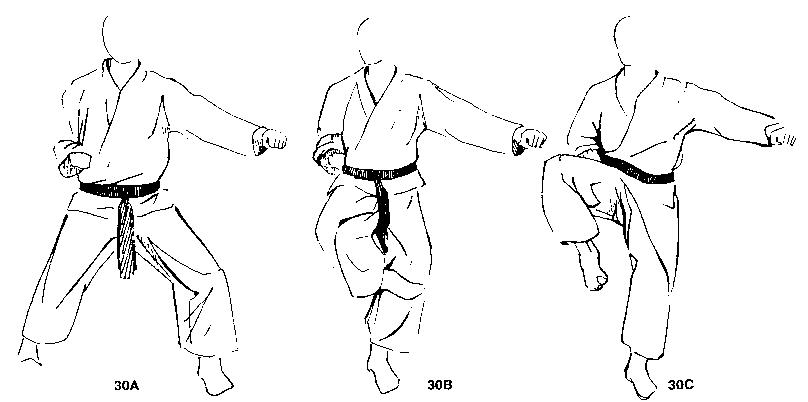
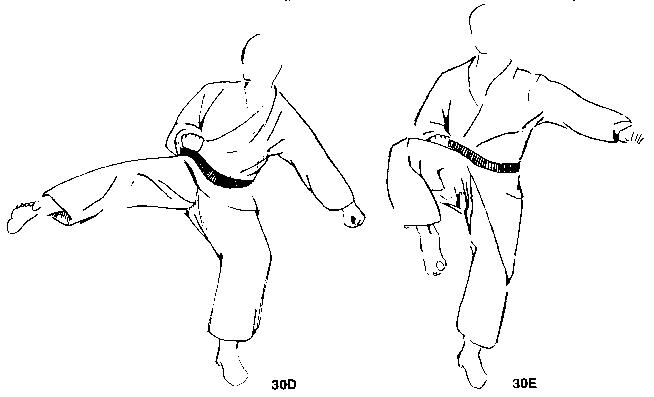
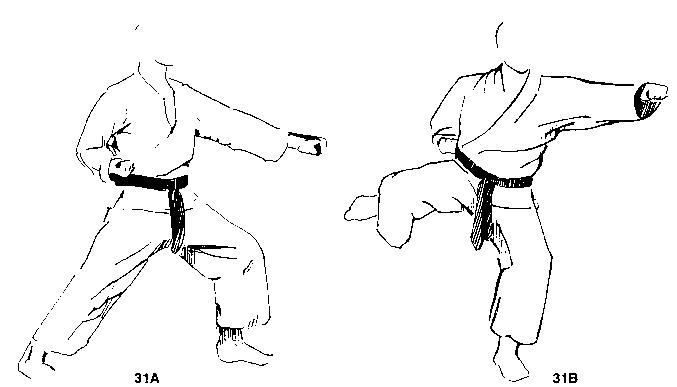
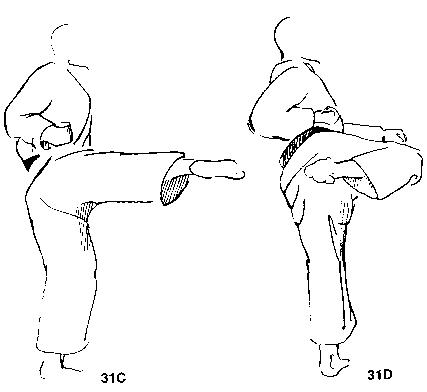
This HTMl version was prepared from ASCII file https://www.ingber.com/karate76_book.txt
N.b.: This text was prepared by applying standard OCR software to scan in
the actual pages of
%A L. Ingber
%T The Karate Instructor's Handbook
%I Physical Studies Institute-Institute for the Study of Attention
%C Solana Beach, CA
%D 1976 I am permitted to do this since I own the copyright to this book.
I thank Rick Sorensen <RSorens@aol.com> for preparing many corrections to the first OCR version.
Illustrations, arrows marking directions, are missing, footnotes likely are out of place and not well correlated to the text, the two-column format confused the software at times in the appendix of combinations, etc. I have not taken much time to edit this file afterwards. I hope what remains will be a useful guide for some karate students and instructors.
5 Nov 08
I added the Epilogue which I scanned from one of the few remaining texts in my
possession.
A collection of notes and edited replies to postings and e-mail on karate is in https://www.ingber.com/karate.html or https://www.ingber.com/karate.txt
The 134 combinations and 16 two-person combinations in Appendix 4 are representative of over 5000 combinations I created and taught from about 1969-1985. Unfortunately, the collection was lost in one of several moves, along with many other documents. This includes the loss of multiple manuscripts, e.g., Principles of Nature, described in the Epilogue to this text, which ran quite a few hundred pages in length.
The original ideas were first formally presented in
%A L. Ingber
%T Physics of karate techniques
%R Instructor's Thesis
%I Japan Karate Association
%C Tokyo, Japan
%D 1968
There are many useful parallels that can be drawn between the teaching and
practice of karate and the teaching and practice of other disciplines. This was
the core of an 8-year project I undertook, funding, administrating and teaching
in a complete alternative school. This was also tested in a UCSD Extension set
of courses.
%A L. Ingber
%T Editorial: Learning to learn
%J Explore
%V 7
%P 5-8
%D 1972
%O URL https://www.ingber.com/smni72_learning.pdf
Some of this methodology is described in karate81_attention.pdf (a link to
smni81_attention.pdf).
%A L. Ingber
%T Attention, physics and teaching
%J Journal Social Biological Structures
%V 4
%P 225-235
%D 1981
%O URL https://www.ingber.com/smni81_attention.pdf
Appendix 5 of my 1976 karate book contains 6 representative karate problems
along the lines of over 2000 problems created by myself and other teachers, as
described in karate81_attention.pdf. These too were lost in one of several
moves.
NOTE: I welcome offers to proof-read this file (and/or the file karate81_book.txt and/or karate85_book.txt) to correct many errors made by the scanning software.
Lester
========================================================================
========================================================================
THE KARATE INSTRUCTOR'S HANDBOOK
by Lester Ingber, PhD
Copyright 1976/Institute for the Study of Attention, Inc./PO. Box W/ Solana Beach, California 92075
All rights reserved. No part of this book may be reproduced in any form or by any means without permission in writing from the Institute for the Study of Attention.
Printed in the United States of America
TABLE OF CONTENTS
Foreword by Don Edwards                                                 IV
Introduction                                                            v
Chapter 1       PHYSICS OF KARATE TECHNIQUES AND BODY ATTENTION         1-1
                A. Forces and Body Concentration - Stance               1-2
                B.Momentum and Directed Body Concentration -
                 Punching, Blocking, Kicking, Striking                  1-7
                C.Energy and Expanded Body Awareness -
                 Rhythm, Timing                                         1-32
Chapter 2       SENSORY NATURE                                          2-1
                A. Sensory Attention                                    2-1
                B. Timing = Focal-Synchro-Plenum                        2-2
Chapter 3       SENSORY NATURE APPLIED TO KARATE                        3-1
                A. Attention Exercises - Body, Visual, Auditory         3-1
                B. Sparring                                             3-4
                C. Kata and Combinations                                3-8
Appendix I      NEUROLOGICAL REFERENCES                                 APP 1-1
Appendix 2      KARATE TRAINING SCHEDULE                                APP 2-1
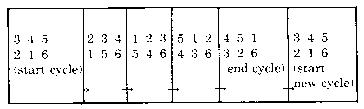
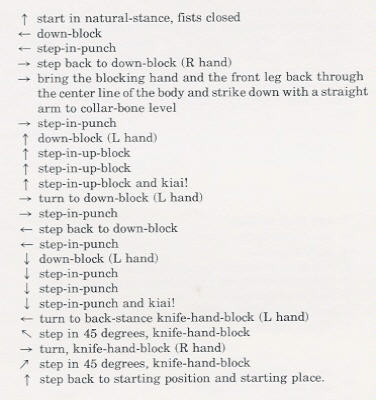
Appendix 3      FIRST KATA                                              APP 3-1
Appendix 4      KARATE COMBINATIONS AND TWO-PERSON COMBINATIONS         APP 4-1
                Two-Person Combinations                                 APP 4-17
Appendix 5      ISA KARATE PROBLEMS                                     APP 5-1
Epilogue Table of Contents & Introduction to Principles of Nature,
                sequel to The Karate Instructor's Handbook              I
Index                                                                   INDEX-1
INTRODUCTION
This text represents a 10-week basic course I have taught for several years. Beginners as well as black belts take this basic course continually to sharpen their mental and physical techniques. This book, which also explains the rationale behind the body and mind exercises, can even be used by a beginning karate student aided. by an instructor, as well as by instructors who strive to teach karate as a means of achieving a harmony of mind activity and body movement through detailed explanation and examples. Therefore, despite the fact the presentation is extremely technical and thorough, the book is written as if it were being presented to the beginner. I believe this makes the book even more valuable to the instructor.
The emphasis of this book is to teach karate as a means of studying the dynamics of body and mind as an end, a purpose, in itself. However, to become proficient and creative in any activity certainly demands specialized, disciplined practice in that activity. Therefore, if you want to practice karate for self-defense, for sport, or for form, your regular practice must be primarily oriented along that path. Then this book will be an important Supplement to your training, because the awareness and training of body and mind dynamics are essential to any use of karate.
Although this book uses the Shotokan style to illustrate karate techniques, it rapidly becomes apparent that the body and mental languages developed are extremely basic to all styles of martial arts, as well as to other physical disciplines and sports.
Once the processes behind the physical and mental activities are grasped in relation to specific techniques, a full spectrum of body and mind activity becomes available. For example, virtually all students after one month's practice can acquire the intuition and technique necessary to do the combinations given in Appendix 4. Often, new or unpolished techniques are "slipped in," and the student is left to his/her own devices to plunge through the combinations and learn the new techniques in the context of the exercise. Experience shows this is the best way to learn any language, including a body language.
This book and its sequel '1 are attempts to show that every subject or discipline - be it physical or cognitive activity, or interaction with other humans, or with inanimate nature can be broken down into Process plus Content, the information peculiar to the activity itself. Often the process is inferred from realizing both the content and the subject in its entirety. I have presented "existence proofs" in the form of supportive analyses to demonstrate that the Process is that of consciousness itself This need not distract or detract from the meaning and information inherent in these subjects and disciplines; indeed it serves to enhance them.
'1 Lester Ingber, Principles of Nature.
I do not agree with the thrust of our technological society that tends to strip us of our humanness, nor do I agree with most counter-culture forces that demand we abandon content for the sake of consciousness. Indeed, the purpose of this book is to illustrate by specific examples that content and consciousness can and should exist symbiotically. In this way both individuals and societies can best grow in their physical, cognitive, emotional, and spiritual interactions.
I wish to give special acknowledgments to some of the many people I have interacted with to complete this book. Lorry Kennedy did the karate illustrations using snapshots of me as a guide. Ann Elwood edited the first draft. I thank many of my karate students for much relevant advice throughout the many stages of preparation of this book.
>From 1970-1972 1 realized that for the previous twelve to fourteen years I had not functioned according to my own expectations as a student, as a teacher, and as a researcher both in various physics departments of academic universities '2 as well as in karate institutions.'3 I realized the fault lay not only within myself, but also within impersonal institutions, which did not seem to care about developing processes of consciousness to give meaning to content. Accordingly, I resigned from these institutions with the belief that I could do more for myself and others in an institution, the Institute for the Study of Attention, Inc. (ISA),'4 which was better designed to help society and its individuals. I feel that I have been proven right. I am indebted to all the past and present students and staff of ISA for providing me with continual inspiration and feedback on the major ideas presented in this book.
Lester Ingber
'2 California Institute of Technology; University of California at San Diego, Berkeley, and Los Angeles; State University of New York at Stony Brook.
'3 Japan Karate Association and the All-America Karate Federation.
'4 ISA was established on October 28, 1970 as a nonprofit scientific and educational California corporation to research attention and to apply findings to improve our educational and social institutions. Some of ISA's activities involve research as reported in this book, and an alternative school offering a rich program of small classes in academics, fine arts, and physical disciplines to students over 12 years of age interested in discovering and applying their creative processes. The research at ISA includes the formulation of models of sensory, cognitive, human, and inanimate natures, stressing their common underlying processes.
CHAPTER 1
Physics of Karate Techniques and Body Attention
This book is both a training manual and a study of how consciousness operates in physical disciplines, specifically karate. It will show the professional as well as the amateur how to develop methods within any activity to study specific processes of attention, instead of leaving it to chance to acquire this mental training.
Both physical and mental disciplines can be usefully dissected into Process (consciousness) and Content (meaning and information):
Activity = Content + Process (I- 1)
Karate is a martial art with body and mental languages basic to all styles of martial arts as well as to other physical disciplines and sports. It lends itself extremely well to a study of consciousness mainly because it is relatively easy to separate the dynamics of its body language (content) from the dynamics of the mind (process): If an activity is well understood - typically by the method of total immersion and if the content likewise is understood to an extreme degree of precision - extremely focused techniques, for example - attention processes may easily be inferred, as the above equation implies. In standard karate training, the content, or the physical technique, is acquired largely through basic practice and is geared to the performance of accurate, sharp, and precise total body movements as an end in itself. In most competitive sports, including sport karate, it is possible to achieve success in the activity without understanding the content or the process precisely, mainly because the object is to win against a human opponent rather than to develop a more "perfect" body language. However without precise understanding of the physical content, it becomes more difficult to infer the mental process by virtue of doing the activity. Only by clearly understanding the mental process can applications and training be purposely made to other disciplines and to life itself.
A complete course in karate is presented in this book. It is ideally to be used as an Instructor's handbook, to supplement the interests, and energy, and previous training of a dedicated Instructor. In the absence of an Instructor, if you try to learn from this book, do so with full commitment. Like all disciplines, physical or cognitive, karate requires dedication, and you will learn only a little by trying in a superficial way:
i hear, and i forget
i see, and i remember
i do, and i understand
Chinese proverb
"To know something is not merely to be told it or to act upon it, but to modify and transform it and to understand the process, and consequences, of the transformation." Charles E. Silberman, Crisis in the Classroom, New York, Vintage Books, 1970.
It is usually very difficult in any discipline to separate content from process. However, the question often arises: in any physical discipline, what can be explained in terms of the body, and where exactly does the mind enter into the picture?
If the processes by which the content, or body movements, are synchronized with the attention processes are not understood, then people are tempted to attribute great powers to those who are physically skilled, when in truth their movements, magical as they may seem, can just as well be explained in terms of simple physical principles.'1 After isolating these principles - e.g., forces, energy, momentum - and using them to explain body movement, it is then much easier to explain and appreciate how they synchronize with the mental processes, to be discussed later in the next two chapters.
'1 For example, in karate and aikido, both Oriental martial arts, some practitioners claim to feel a great supernatural power from the magic known as ki, or life force. Insofar as this power comes from explainable changes which create momentum and energy, the idea is false metaphysics. (That is not to say that there is not some acquired mental correlate which makes the learning of the body skill more efficient.)
Physical disciplines have languages made up of movements which can be put together much like the vocabulary of languages to communicate meaning. Many of the basic movements are common to most, or all, physical disciplines - stance, for instance, is of extreme importance in any sport. The techniques of karate in this chapter, the body language, are outlined in terms of natural physical dynamics. This structure will help you not only to analyze general body motion but also to develop your body into a finely honed tool to further explore concentration and awareness.
The Karate described in this book is Shotokan style. To it, I have added some ideas of my own, which come from my involvement in physics and my studies of consciousness. However, all physical concepts are discussed here independent of style, discipline, instructor, or guru. The physical and mental processes taught here are essential to learn karate for any reason, for development of consciousness, for self-defense, or for sport karate. The instruction is presented to enable you to learn most efficiently how to perform the techniques and movements. Use the Training Schedule in Appendix 2 to make the best use of this structure.
Training is usually comprised of learning and practicing the following:
1.Individual techniques - e.g., punches, strikes, kicks, and blocks.
2.Defense-attack sequences, sparring with an opponent.
3.Combinations of eight to ten techniques, sparring with your imagination.
4.Kata - ancient stylized forms, or combinations. In Shotokan style,'2 there is one form practiced for each of the kyu levels (usually 2 white belts, 3 green belts, 3 brown belts), and there are approximately 15 basic advanced forms that black belts choose from. The first kata is given in Appendix 3.
'2 These katas are described in Gichin Funakishi, Karate-Do-Kyo-han, Tokyo Kodansha International Ltd., 1973.
When practicing karate, it is very important to use big full motions so that the body can first learn correct power methods (muscular coordination and proper tensions) which later can be applied to shorter motions. Try to keep your eyes always on and all over your opponent real or imaginary; this causes a slight defocusing of vision.
Remember that you are learning karate to study consciousness, not to annihilate attackers. All techniques, especially sparring, should be performed to provide feedback on consciousness states, not to hurt your opponent or yourself; broken bones inhibit correct training!
A. Forces and Body Concentration
Karate techniques are designed to deliver large impact forces to their targets; to attain such forces, the attacking body must possess great momentum. The usual way to attain such momentum is to apply a force to a large mass and quickly accelerate it to an extremely high velocity; momentum is defined as this mass multiplied by its velocity. The force required is approximately equal to the final momentum available, inversely weighted by the overall time interval. When this force is applied to a small target area, tremendous pressure force divided by target area - capable of producing shock and sometimes breakage is created.
At first glance, it may seem that the human body is not well designed to accomplish this feat - that the attainment of large mass and the attainment of great speed are mutually exclusive: On one hand, large masses can be created by tensing and connecting the heavy parts of the body, making it a rigid extension of the floor; but in this state the body is too stiff to produce any speed. On the other hand, great speeds may be attained by the arm or leg when propelled from the supported torso and stance, much as a stone is shot from a sling; however, this fast-moving limb does not have a large mass on impact. To achieve both mass and speed, the arm or leg which has been shot from the torso and stance can be tensed just before impact and reconnected to the torso and thus to the large mass of the lower body which is connected to the ground by the stance leg(s). However, while this technique attaches a large mass to the limb, it eventually slows the limb down. There is a compromise which assures that maximum momentum (mass x velocity) is available upon impact with target. Depending on the target and the strategy, various proportions of mass and velocity may be selected to contribute to produce large momentum.'3 This is the essence of "focus."
'3 The small time interval perceived during impact gives the karate a finely tuned probe into his/her own states of consciousness. These techniques, controlled by the somatic sensory and motor centers of the brain, may be most accurately expressed in terms of simple physical principles. I examined parameters of focus in 1969 with the aid of an accelerometer attached to a target. An oscilloscope read out the acceleration of the target as a function of the time passing during impact. (I called the set-up an Impactometer.) The data seemed to correlate with reality, and when I went to the State University of New York at Stony Brook in 1970, two undergraduates worked with the Impactometer as a class project. Unfortunately, near the end of the term there was a student strike reflecting disgust with the invasion of Cambodia by the United States military. I left soon afterwards and all that remains of the Impactometer study is a neatly written, but incomplete report. The information will eventually be of use to others who want to build equipment to measure impacts in various physical activities, If the parameters of force - mass, velocity, duration of impact - are separated, then separate training methods as discussed in this chapter can be used to strengthen the weaknesses of average practitioners as well as accomplished athletes. Of course, such application of the ideas to help an individual requires the intuition and guidance of a creative instructor.
The source of power needed to generate techniques in karate can be traced to
proper use of the legs in a stance. Stance is the term used to describe the
legs when they are in tension and connected to each other by the continuation
of this tension through the center of the body. The two basic types of stance
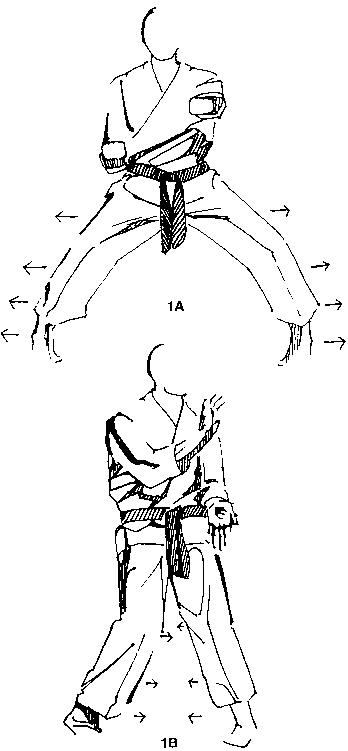
are outside-tension stance and inside-tension stance. Figure 1A shows the
direction of tension in the side-stance, an outside-tension stance; Figure 1B
shows hour-glass-stance, an inside-tension stance. (See Appendix 5 for an ISA
problem comparing a karate stance with a t'ai chi stance.)
[Figure 1A-B]
As you will examine in detail, the stance provides the forces and torques to move the torso, which in turn spins off the arms and legs. (A torque, which is produced by two or more forces acting in opposite directions at each end of a lever, is necessary to rotate the body about a given point in space. In contrast, only a single force is necessary to cause the motion of the body along a given straight line in space.) The forces from the stance are therefore important to accelerate the limbs. Upon impact from a blow, the stance also provides rigid support to help establish a large grounded mass behind the technique.
The proper stance is also necessary to acquire a smooth quick start for most techniques. Rather than first pushing against the ground with your back leg and using the resulting reaction force from the floor to push forward (just like walking) you can release the front leg of the stance, thus allowing the back leg which is already driving forward to push the body directly and smoothly. This use of stance will be discussed in detail in the section on punching.
Exercise 1
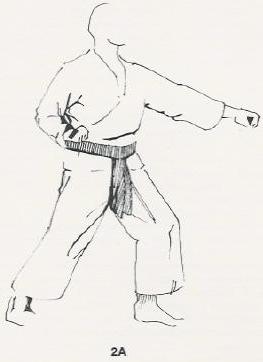
FRONT STANCE. The general outline of any stance can be analyzed using three
basic concepts: balance, power, and mobility. Maximum balance is obtained when
the center of gravity is low. However, if a stance is too low, it is extremely
difficult to use the inside thigh muscles to move the body, and power and
mobility are lost. To take the proper long distance for the front-stance, begin
by placing your left foot about two and one half shoulder-widths ahead of your
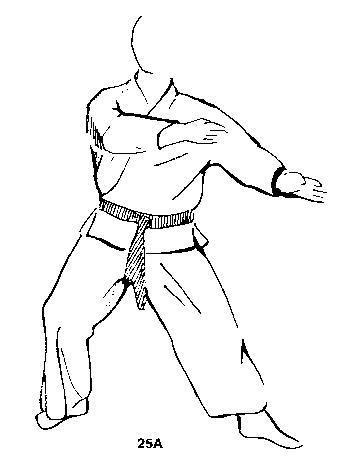
right foot.'4 Figure 2A is too short, Figure 2B is just a little too long, and
Figure 2C is about the right distance between the heels.
[Figure 2A
Figure 2B-C]
'4 All stances should also be practiced in mirror image e.g., with right foot forward.
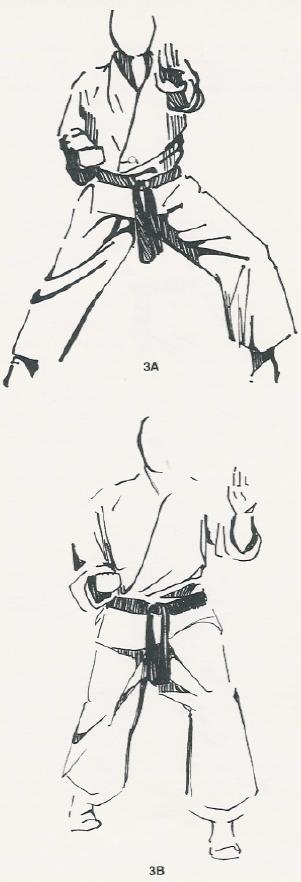
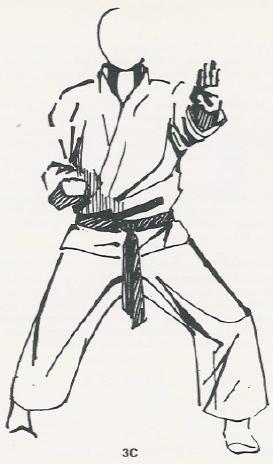
To determine the width of the front-stance, along a line perpendicular to
the one in which you are facing, consider balance: Too narrow a stance makes it
difficult to maintain balance, and too wide a stance is not stable against
recoil upon impact. A good estimate of the proper distance is one
shoulder-width between your feet. Figure 3A is too wide, Figure 3B is too
narrow, and Figure 3C is about the right width.
[Figure 3A-B
Figure 3C]
To best direct power from your back leg, turn your right ankle in towards center as much as possible (30 to 45 degrees), but still keep the entire sole touching the floor. The side edge of your front (left) ankle should be parallel to the line of motion - toes turned slightly in. If your ankle is turned in too much, mobility is lost; if it is turned out too much, your leg muscles are stretched out and cannot develop maximum power.
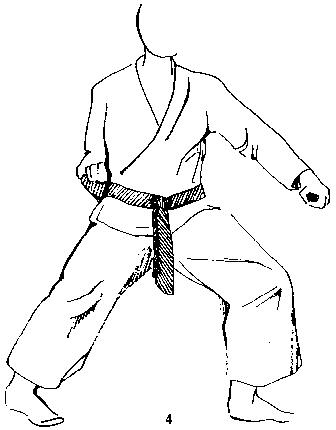
Your left knee should be positioned directly over your large toe. If your
knee is not bent enough, the reaction force from a simple punch will push your
hips back. If your knee is bent too much, the sharp angle will become a weak
point, because tensing the outside muscles of a sharply bent limb produces a
weak corner. (Consider building a bridge shaped like a "VI, or an "A"!) If your
knee is bent correctly, muscles can be tensed to construct a smooth arch of
tension on the inside of your legs (Figure 4): Forces travel faster in a medium
with strong elastic forces between its building blocks; therefore the forces
from the stance will travel more efficiently through the strong arch of the
inside of the knee rather than travel across the top of the (relatively more)
relaxed musculature of the top of the knee.
[Figure 4]
The principle of providing smooth arches of tensed muscle to direct the flow
of forces is utilized over the entire body. Many disciplines, notably Aikido,
stress the principle of smooth arches of tension as a necessary component
towards developing a proper flow of Ki (life-force) through the body and into
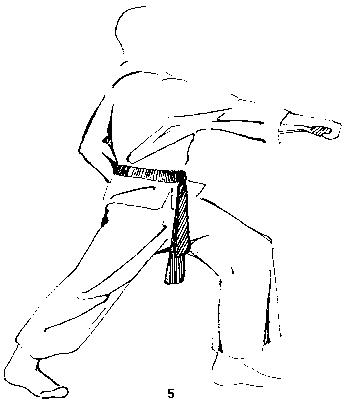
the target or environment. Figure 5 illustrates the form of a counter-punch.
More important than the outer appearance of the form are inner tensions under
the arm across the abdominals, and across the insides of the thighs to produce
an unbroken connection of smooth arches.
[Figure 5]
BREATHING, HIP FEELING, NATURAL STANCE, KIAI. Breathing and proper hip feeling are so fundamental to all techniques that the following exercise should be done as part of the beginning warm-up of each session for at least the first couple of weeks. Your hip center must be properly tensed to transmit the forces and tensions between the legs, through the torso, and out to the external limbs. The iliopsoas (short double muscle high on the thigh and hip), internal oblique (middle layer of abdominal muscle on the sides), transversus abdominal (innermost layer of abdominal region), and sartorius (long narrow muscle connected to the spine that winds downward and inward across the thigh,) muscles must be tensed from the inside of the hip so that the inside thigh muscles can bridge forces through the hip center to the torso.
Exercise 2
Stand in natural stance, your feet about a shoulder-width apart, body relaxed. To avoid tensing to form just a shell of hard muscle, put one hand on your rectus abdominis (outermost layer of abdominal muscle that runs from the pubis to the ribs) and the other on your gluteus maximus (buttocks) and tuck up the lower trunk by flexing the iliopsoas, keeping the outside layers of muscle rather relaxed; this movement necessitates the tensing of the inner muscles and pushes up the diaphragm, expelling air. Slowly tense the most inner muscles you can feel, starting at a point projected midway along a line between your navel and your tailbone, then gradually allow this compression to expand radially outwards until the outer rectus abdominus and gluteus maximus muscles are also tensed. As you tense, the diaphragm is slowly pushed up expelling air; when you release, the diaphragm lowers and air is automatically taken in. At the peak compression you should notice a solid feeling of connection across the legs and through the torso.
Now do the same exercise at a faster tempo until the air is forcefully expelled as the hips quickly tense. Simultaneously tense the ribs to effect "high" rapid breathing. This rapid expulsion of air together with the associated noise that usually accompanies this movement is called a Kiai (life-breath). The kiai is not practiced to frighten unworthy opponents! It is used to aid the body to focus energy, much the same as a grunt enables you to lift a heavy weight.
Hold the hands overhead and continue the radial compression described above to include the back, sides, neck, legs, arms, feet and fists; make the fist by folding all the knuckles into a ball, capped by the thumb placed under the first two fingers, and keeping a straight line from the elbow through the lowest knuckle of the second finger. A fist, in karate terminology, is this complete body feeling centered in the hip!
Exercise 3
SIDE-STANCE. The front-stance is easiest for beginners to learn because it faces forward and because the back leg directly pushes the hip forward via the reaction force from the ground; this is a familiar feeling when walking or running. The side-stance is somewhat more subtle.
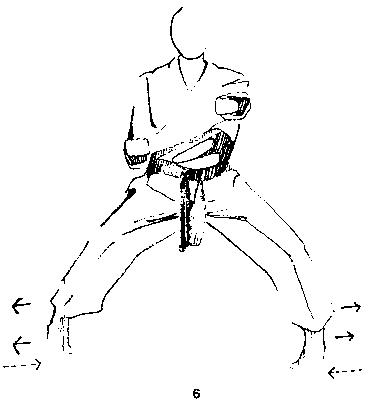
The feet are as far apart in the side-stance as they are in the
front-stance. The tension across the legs and hips allows the body to deliver
power to either side. In the side-stance, the knee and lower leg (actually the
smooth curve inside and across the knee) push out, and the floor pushes back
(Figure 6). When doing side-stance, be sure to keep the outsides of the feet
parallel and the hips tucked in. An outward circular tension exerted around
each thigh will keep the back and inside of each leg tense.
[Figure 6]
Exercise 4
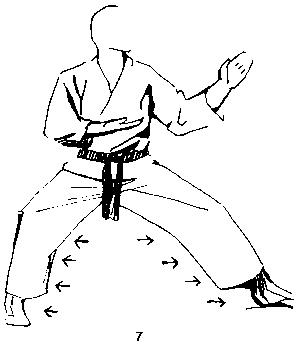
BACK-STANCE. The back-stance is half side-stance and half front-stance. Your
back leg is used somewhat as in side-stance, though it is bent even more. Your
front foot is twisted out at an angle so that its outside edge is parallel to
the line between your heels. The knee of the front leg is only slightly bent;
any locked joint prevents an even tension from flowing across it. Except for
the opposite direction of the ankle, the front leg of the back-stance resembles
the back leg of the front-stance in its direct method of pushing into the floor
(Figure 7). The heels are along the same line to prevent the production of
torques on the hip that would break balance.
[Figure 7]
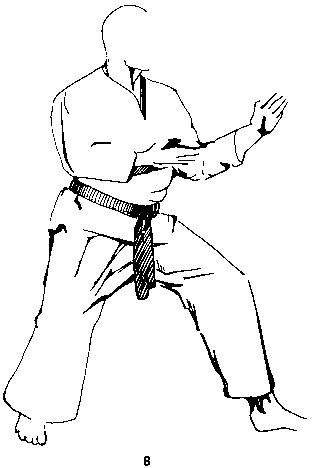
Figure 8 stresses the imbalance caused by not tucking in the hips.
[Figure 8]
ASIDE ON STANCE. For completeness, the other stances are briefly described. The practice of these techniques, utilizing the above principles, will be done within the context of the Combinations in Appendix 4.
The angled-side-stance is realized by placing the feet in side-stance at an angle of 30-45 degrees to the direction you are facing. This stance is capable of making and focusing power in all directions, although it is not as strong to the front as front-stance, or as strong to the side as side-stance. A smooth band of tension circling the legs should be realized.
The half-moon-stance is the inside-tension analogue of the outside-tension angled-side-stance. Take the distance between the legs the same as angled-side-stance. The back ankle is turned in almost forward, and each knee is pulled towards the inside of the opposite ankle. More correctly, smooth curves of tension pull towards each other, from the soles of the feet up to the imaginary extensions of the legs meeting at the solar plexus. Be sure the hips are tucked under to lock these two tensions together.
When sparring at close distances, often the feet must be close together. At distances between the legs approaching a shoulder's width, the angle between the thighs in front-stance becomes too small to produce an effective horizontal component of force to push against the ground to derive strong body power. The hour-glass-stance (Figure 1B), an inside-tension-stance, solves this problem. This stance is essentially the same as the half-moon-stance, except that the large toe of the back leg is on a line that passes under the center of the body and through the heel of the front leg. The relevant angle for making power is roughly measured by intersecting lines along the lower legs that pass through the knees; this angle is much steeper than the angle between the thighs in a front-stance with the same foot to foot distance.
Similarly, the cat-stance is the inside-tension analogue of the close-distance outside-tension back-stance. It is produced by pulling the front leg of the hour-glass-stance over until the heel is just in front of the big toe of the back leg; the front heel is raised and the thighs are pinched, crossing the front knee over the back knee. As in all the inside-tension stances, the tensions in the legs should be extended up to the solar plexus.
When kneeling, or on one knee, the stance principles remain the same. The concept of stance can even be applied when lying on the floor. Then (preferably) both hands grabbing the floor and one thigh can be used much the same as two legs to produce power across the hips to execute a kick with the other leg.
The before-stance is the stance used to initiate the body dynamics. This may be applied from any natural position just as the technique begins. The after-stance is the stance used to put mass into the focus of the technique. This latter stance need not always be present if you already possess a large momentum directed towards your target. Only if this principle is correctly applied is there a rationale for flying-kicks and strike-snap hand techniques from somewhat weak stances, both to be practiced in the context of the Combinations in Appendix 4.
CENTERED SOMATIC (BODY) CONCENTRATION. The practice of stance provides a direct method of developing a sense of "center" - a most important ingredient of any body discipline or meditation which can easily be generalized to all of life. In the outside-tension stances, the point in the hip to which the opposing forces through the legs meet defines the term "hip center," or "body center" used in this book. This point and its associated somatic '5 (meaning body) feeling enables the chartist to maintain and utilize control over his/her own body. As will be explained more precisely in the next section, this self-control is essential to controlling an opponent(s) and the external environment.
'5 In the somatic system, there are three subsystems: (1) the interceptive nervous system going to the viscera; (2) the proprioceptive system going to the skeletal frame; (3) the exteroceptive system pointing to the outside world.
B. Momentum and Directed Body Concentration
Exercise 5
You can test the tensions in the legs with the help of an opponent. Both take a front-stance, left leg forward, opposing each other at a distance such that your outstretched palms, with elbows locked, barely touch each other. One side pushes as the other side continually offers some resistance. You start first as the pusher: Stand with the correct opposing tensions in your legs, then suddenly pull in your front leg so that it no longer opposes your back leg; your back leg is now pushing, and your front leg is pulling. Your opponent is gradually driven back as your front leg continues to pull until your legs cross. Then the left leg becomes the new back leg, pushing away from the body, continuously driving you forward and the resisting opponent backwards. After one full step is completed, relax your arms, and stop your forward motion by pushing your front leg into the floor setting up opposition to the back leg. You are in a new front-stance. Now repeat the exercise.
Exercise 6
A similar exercise is done by holding your opponent's wrist, then stepping back, pulling your opponent with you. Keep the hips tucked in, and be sure to start by driving the front knee forward to drive your body back. Similar precautions regarding the hips and knee pressure should be kept in mind when doing other exercises with side-stance, back-stance, and the inside-tension stances.
Until this point, we have considered the forces at work in stances as static forces - that is, attempted pushing and pulling of immovable objects. Once you understand this body feeling, you can apply it to produce dynamic forces that accelerate the body, arms, and legs.
BODY VIBRATION. The first mode of dynamic power to look at is the production of vibrations in the torso.
Exercise 7
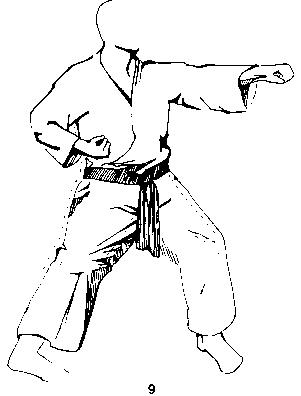
This method is illustrated by punching from side-stance. The tension across
the legs in the side-stance is similar to that in a taut guitar string. One
hand (pulling hand) pulls back, "plucking" on this tension to produce a body
vibration. Once the large muscles of the body are moving together, it is easy
to use them to throw the other hand (punching) off the hip to the target.
Instead of using vibration energy to produce sound, as in the case of the
guitar, the hip energy is directed into building the momentum of the punching
arm. Figure 9 attempts to illustrate this; the dotted lines show the position
of the body a split-second before the first vibration.
[Figure 9]
We now make a digression from body dynamics to discuss punching in more detail, so that you will immediately have at your disposal one full technique using torso, arms, and legs. Practicing this technique will enable you to study the more subtle aspects of karate.
Exercise 8
PUNCHING. The trajectory of the punch must allow the arm to be most receptive to the transfer of power from the body. Place your right fist, palm up, at the soft spot between the bottom of the rib-cage and the top of the hip bone. This position keeps the biceps muscles relaxed and the elbow close to the hip. Hold your left arm straight out in front of you so that your fist is level with your solar plexus. Then move your right fist forward while pulling your left fist back to its hip position. As the punching elbow clears the hip, a little resistance can be felt from the arm muscles, so it is most natural to allow the forearm to twist, giving a shearing motion to the punch. Throughout the punch, minimize tension on the outside of the arm and over the shoulder to maintain a smooth arch under the arm - tensing the serratus anterior muscles to transfer the forces. Again, it is important in all movements to synchronize physical moving and breathing. Proper coordination between hundreds of muscles is best learned by synchronizing them with the beginning and end of a breath.
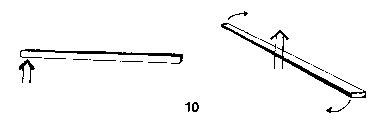
PULLING HAND. The pulling hand aids the punching by setting up the correct
reaction forces to initiate the body dynamics. If you imagine a pole placed
horizontally across the torso, you can easily visualize how the pulling hand
sets the body in motion to throw off the punching hand. A force on one end of a
pole causes a rotation about the center of the pole.
[Figure 10]
We can now return to hip dynamics and the use of new power methods to drive the punch.
SHIFTING. Recall that the first mode of dynamic power comes from achieving body vibration. The second mode of dynamic power comes from shifting - moving the hip-center to the front, to the back, or to either side. One example, Exercise 9, explains this method.
Exercise 9
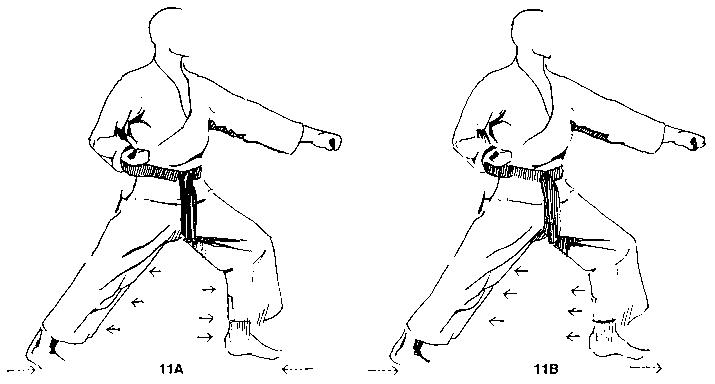
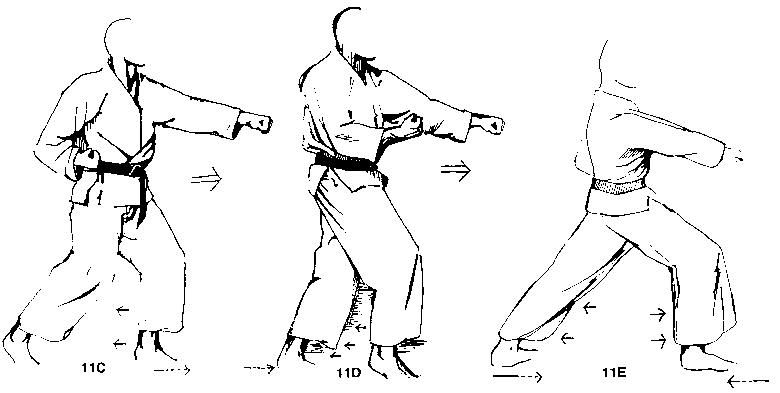
Step from front-stance (left leg forward) one full step ahead to a new
front-stance according to the following sequence: Opposing forces should
already exist between. your legs (Figure 11A). Your front leg, which now
controls the entire motion, changes its direction of force from pushing away
from the body to pulling with the inside and back thigh muscles. The effect of
this movement on shifting is twofold. Releasing the outward force allows the
pushing force from the back leg to drive the body forward; in addition, this
motion of the body is aided by the pulling scissor motion of the front pulling
leg (Figures 11B & 11C). As your legs cross and the direction of force
again changes, your left leg now becomes the back leg for the next front-stance
(Figure 11E). The left leg now pushes away from the body, driving it
continuously forward, until the right leg brakes the forward motion by coming
to rest (Figure 11E). This exercise and the next exercise (Exercise 10) are
quite similar to Exercise 5. Exercise 5 required a steady push against a
receding opponent, while this exercise and Exercise 10 require a similar body
feeling to accelerate the body continually through a full step.
[Figure 11A-B
Figure 11C-E]
Exercise 10
STEP-IN-PUNCH. The punch may be coordinated with the body motion of shifting. Begin in front-stance, left leg forward, right fist on hip, left fist forward. Then step in to a new front-stance while punching. The proper technique requires that the arm and body achieve maximum momentum (momentum = mass x velocity) together upon impact. Ideally, your punch should begin when your legs start to move, every body part should smoothly accelerate and reach a maximum focus at the instant you are achieving a new front stance. At first, you will probably not be able to move your legs quickly enough to allow the punch to begin until after your legs have crossed, but with practice, the punch may be started sooner and sooner as the leg movements become more coordinated. Your pulling hand may help the start by creating the desired reaction force in the hip. Use the punch as a self-competitive device to drive yourself to move faster by beginning the punch sooner than you might think possible and yet try to have the arms and legs coordinate to achieve focus together. You might move faster than you thought you could!
Exercise 11
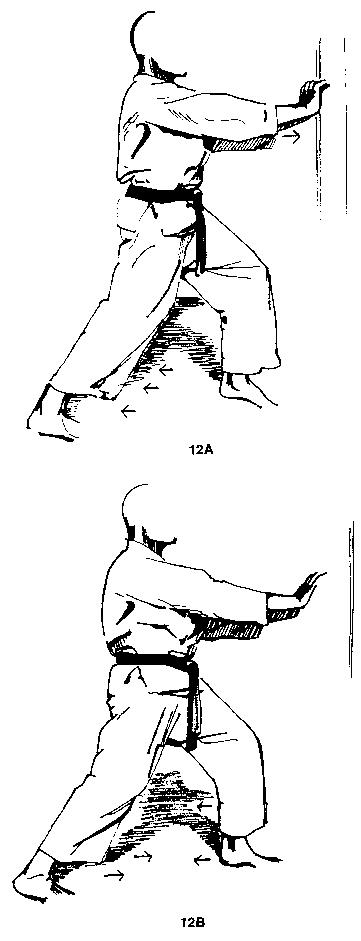
The feeling in the body during these accelerated motions (of the arm with
respect to the body and of the body with respect to the ground) is similar to
that in Exercise 5 or that felt when pushing against a wall while in
front-stance (Figure 12). The force flowing from the back leg through the hip
and arm is met by an equal and opposite reaction force exerted by the wall.
Upon releasing the arms, a reaction force from the front leg is required to
prevent any forward motion. Release your front leg to direct a flow of force
continually from your back leg through your arms, then release your arms to
direct a flow of force through the front leg, and keep rapidly alternating this
flow of force.
[Figure 12A-B]
When accelerating an arm or a leg, similar forces are necessary to overcome the inertial mass. Although the forces have different purposes in static and in dynamic situations, the feeling in the muscles is essentially the same. For example, when doing a step-in-punch, the body should propel the arm and legs with much the same continuous driving feeling as experienced when pushing against the wall. The dynamic reaction forces exerted on the body by the propelled punch are countered by the force exerted by the legs on the body in the opposite direction. Thus the forces necessary to step-in-punch are ultimately dependent on the proper dynamic use of stance for both the arm and body motions.
LINEAR SOMATIC (BODY) CONCENTRATION. Doing big powerful techniques along a line provides a direct method of developing a sense of directing attention smoothly and continuously. In this way the body-centered concentration developed from stance training can be simply and usefully channeled, permitting direct control of an opponent(s) and the external environment.
Exercise 12
ROTATION. Another movement that takes advantage of dynamic forces is hip rotation. A more complete discussion of the dynamics of rotation will be postponed until striking techniques. We discuss the counter-punch and blocking techniques before thrust kicking because experience has shown that this is a more efficient learning sequence, allowing an earlier introduction to basic sparring. (See the Training Schedule in Appendix 2.)
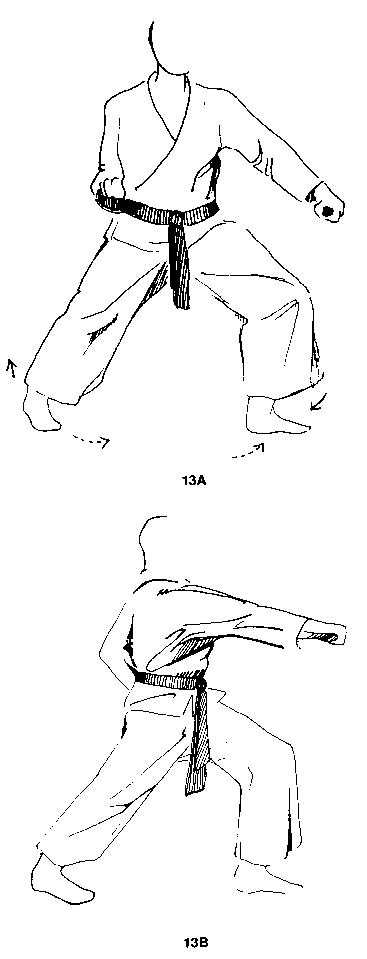
COUNTER-PUNCH. In addition to hip vibration and shifting, the front-stance
can be used to deliver a counter-punch (a 12A punch from the same side as the
back leg). Retaining the tension across the knees, start in front-stance with
right fist on hip, left fist forward. Using circular forces around each leg,
turn the hip about its center (Figure 13). Be careful not to break the primary
tension across the knees. The pulling hand helps initiate this technique by
pulling back on the hip, jolting the large torso muscles and helping them to
coordinate the rotation used to throw off the punching hand.
[Figure 13A-B]
The punching trajectory is the same as described before; the pulling-hand helps the hip to rotate. While only one point of contact with the ground is necessary to move the body in a straight line, it is necessary to have two points of contact to perform a rotation in order that equal and opposite forces can be applied to turn the body about its center. The punch is focused with the body posture of Figure 5.
Exercise 13
The necessity of having two points of contact can be appreciated by having someone press against your fist as you prepare to counter-punch. You have to use both legs in the stance to rotate the hip to cause the desired punching motion.
ASIDE ON PUNCHING. For completeness, the other punches are briefly described. The practice of these techniques will be done within the context of the Combinations in Appendix 4.
When the target is closer to the body than the fully extended arm, the punch is simply focused in the same position it would have on the trajectory of the fully extended punch. When the elbow stops about two fists past the hip, the vertical-punch is performed with the fist in a vertical position, thumb-side pointing up. When the elbow stops next to the hip, the close-punch is performed with the palm-side of the fist facing up; the wrist turns outwards on focus to help lock the punch to the body. Admittedly a poor choice of nomenclature, the short-punch, sometimes called the reverse-rotation-punch, is actually a fully extended punch done with the arm on the same side as the front leg; the "short" title refers to the lesser body power obtained than from the counter-punch. The u-punch is a simultaneous punch to the face and close-punch to the solar plexus, sometimes the spine bends and the head also attacks like the middle prong of a trident. The double-punch is composed of two simultaneous punches.
The rising-punch begins as a punch to the solar plexus level, but just before focus it swings up to attack the face level, usually just under the chin with the top of the knuckles. As with all karate techniques, the body is responsible for this technique's trajectory; the hip-center first tenses vertically, squeezing the punch upwards, then completes its spherical compression on focus at face level.
The round-punch takes a curved trajectory towards the target. This is aided by twisting the punching forearm sooner than in the regular punch. The hook-punch takes a bent (90 degrees) trajectory towards the target. Just as the elbow clears the hip, the forearm turns across the body, parallel to the chest. It is especially important when doing these two punches to maintain a strong tension under the arm-body connection, and to minimize tension along the outside of the arm-shoulder line.
ADDITIONAL ASIDE ON HAND TECHNIQUES FOR PUNCHING. Using the principles developed so far, several hand techniques may be affixed to the punching arm to accommodate various targets and strategies.
The one-knuckle-fist is made by protruding the middle finger's second knuckle before the fist is clenched; this is the main striking weapon. The fore-knuckle-fist is made by protruding the forefinger and placing the thumb almost inside, under the second knuckle, before clenching the fist. The ridge-knuckle-fist is made like the fore-knuckle-fist, except that all the second knuckles are protruded.
Various open-hand techniques are also used for punching. The palm-heel is made with the wrist bent back 90 degrees and the second knuckles of all the fingers closed tightly. The spear- hand is made by keeping the fore-finger straight, curving the next two fingers to make the tops of all these fingers level, and tensing the hand uniformly from the little finger side and from the thumb side. The two-finger-spear-hand is made by slightly curving the first two fingers and clenching the others; sometimes the finger next to the index finger is only half-bent to give additional support to the index finger. The one-finger-spear-hand is made by slightly curving the first finger and half-bending the others for support. All open hand punching techniques are not performed with a shearing component at focus, as this would tend to break the fingers.
BLOCKING, A further digression into blocking illustrates an important use of rotation movements. Hip rotation is useful for attack-blocks, which are designed to break the opponent's rhythm and balance as a prelude to a counterattack. When facing in a given direction, you can effectively direct power perpendicular to an attack over an extremely wide angular region. Attack-blocks are used to defend the face, solar plexus, and groin regions.
Another method of blocking, which is smoother but requires better timing, is sweep-blocking, in which the attacking momentum of the opponent is controlled along a line tangential to the attack. The blocking hand glides along the attacking limb, exerting a gradual sideways force that smoothly deflects the attack. This method of control, used to a great extent in Judo and Aikido, is utilized in some of the timing exercises in chapter 3.
The attack-blocks as well as the attacks follow principles of natural body movements - e.g., one group of muscles should not impede another group's functions. An important application of these principles is: when the blocking (or punching) hand is close to your body, the palm faces toward you, and when the hand is extended, the palm faces away from you. These trajectories minimize arm tensions that could interfere with the flow of power coming from the legs and hips.
Perform these punches and blocks with a muscle connection at the armpit that allows the hip to drive momentum directly through the elbow and send the arm to its target. This connection is somewhat elastic; it is not so stiff that the arm cannot be accelerated away from the body, nor is it so relaxed that the arm remains disconnected from the body.
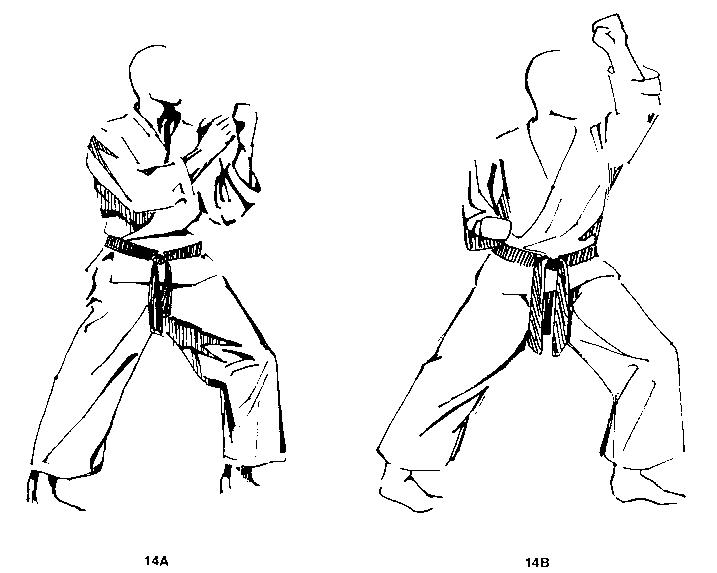
Exercise 14
UP-BLOCK. Begin the up-block as a punch along a vertical line in front of
the center of your body. When your wrist reaches the height of your head, twist
out your forearm to form a smooth curve extending under your arm. The position
of your fist should be about two fist-widths from the top and front of the
head.
[Figure 14A-B]
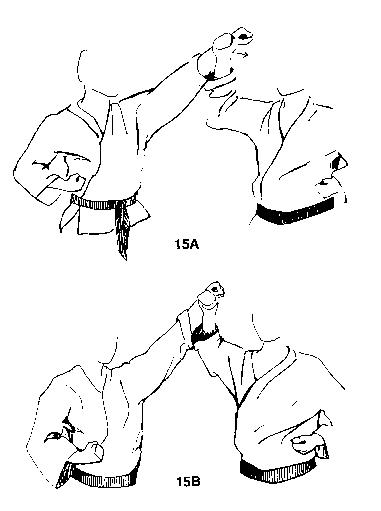
Exercise 15
You can use the extra twist at the end of the up-block to turn your wrist
out for a smoother deflection of the attack. The timing of this twist with the
focus of the block allows you a continuum of blocking methods ranging from a
heavy attack-block that is perpendicular to the attacking line of motion to a
smoother sweep-block that rolls along the attacking line of motion (Figures 15A
and 15B). This variation can also be applied to the following two blocks.
[Figure 15A-B]
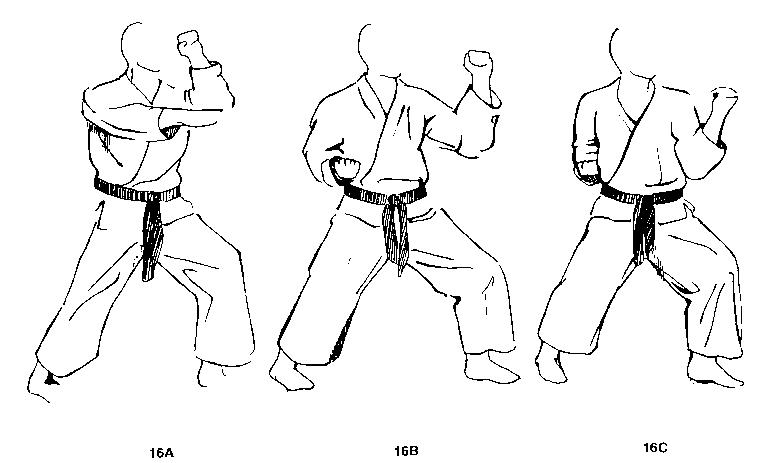
Exercise 16
ROUND-BLOCK. Start the round-block with your arm bent out to the side at
shoulder height and the fist by the ear. A smooth rotation down and toward the
center of the body ends with your palm facing inward at shoulder height with
your elbow bent at a 90 degree angle about two fists' widths from the body.
[Figure 16A-C]
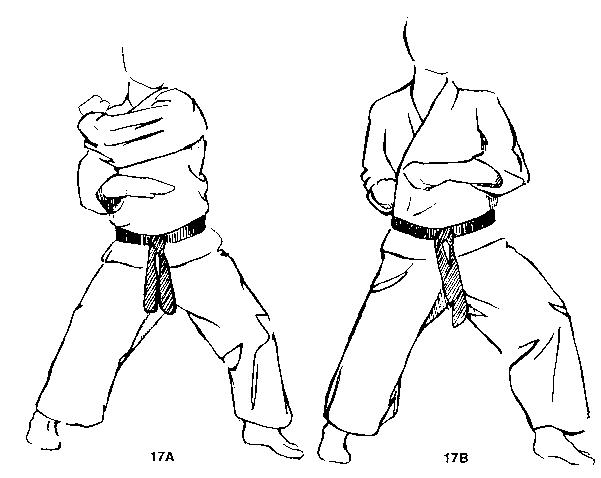
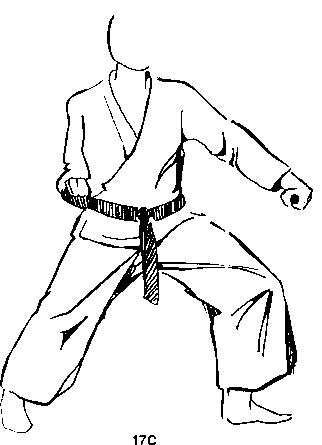
Exercise 17
DOWN-BLOCK. The third basic attack-block is the down-block. Begin with your
fist next to the opposite ear. Swing your arm down across the front of your
body and twist your forearm out just as your arm becomes nearly straight. (If
the elbow locks to make the perfectly straight, a lot of tension is produced on
both sides of the elbow, which prevents momentum from the body from flowing
smoothly through the arm. For similar reasons the back knee in the front-stance
is also slightly bent.) At the focus of the block, your palm should be facing
down and the line of your an-n should be parallel with the front thigh as it
would be in a front-stance.
[Figure 17A-B
Figure 17C]
REVERSE ROTATION. All the blocks may utilize a fourth power method called reverse rotation. (The other three methods are vibration, shifting, and direct rotation.)
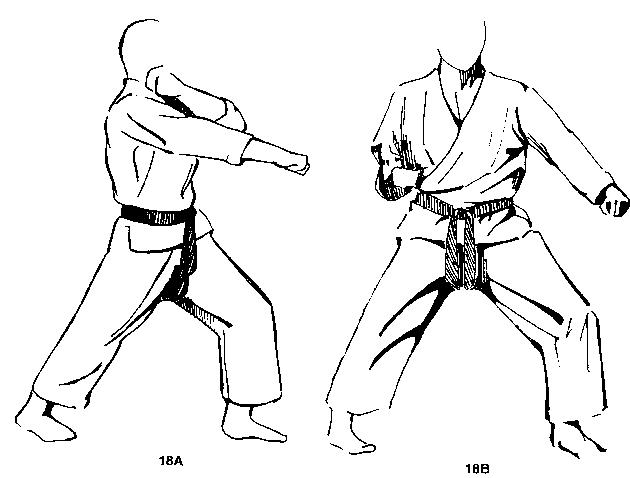
Exercise 18
An imaginary stick can be used to explain this new method of transferring
momentum. In the previous discussion, an imaginary stick was placed across the
body so that the pulling hand caused the body to generate the muscular action
necessary to drive the opposite arm. Now imagine the stick placed along your
arm, and allow your armpit to develop a "swivel-joint" feeling. When your body
now rotates in one direction, your arm will rotate in the opposite direction.
[Figure 18A-B]
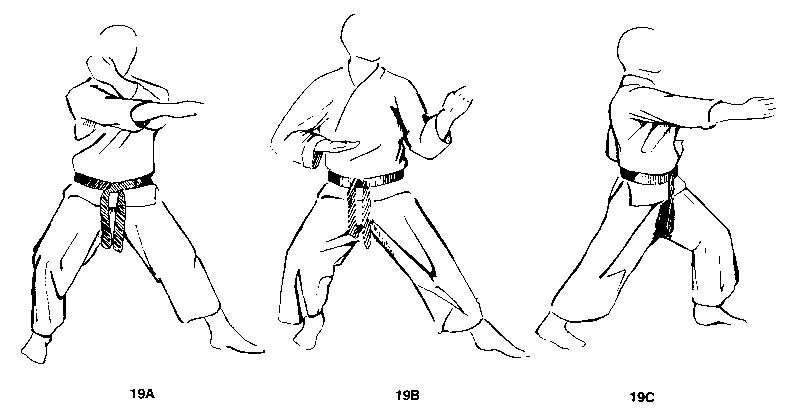
Exercise 19
To demonstrate reverse-rotation, from a standing position (natural-stance) step back to a back-stance, left foot forward, with the open left hand (fingers pressed together) next to the opposite ear. As your hips rotate back to the side position (exposing less of the body), your arm rotates in the opposite direction towards the round-block position. The edge of the blocking hand (knife-hand) twists into the attack (Figures 19A and 19B).
For close-distance sparring the open hand reacts more quickly than the fist.
The back-stance is also useful for close-distance sparring because after
blocking it is easier to change distance to reach with a counter-punch in front
stance. Figure 19C shows a spear-hand-counter-punch, one of many punches that
can be done by using different parts of the hand. This movement utilizes power
generated from both shifting (back-stance to front-stance) and rotation
(counter-punching). In close distance positions, when blocking, usually stop
your pulling hand at the solar plexus region, ready to aid in such a counter
maneuver.
[Figure 19A-C]
In the direct-rotation down-block, the pulling hand is pulled in the direction opposite to the hip movement to act as a brake, focusing the hip rotation by initiating reaction forces causing a reverse-rotation coupling of the arm/hip on the side of the pulling hand. In reverse-rotation down-block, the pulling hand directly helps to rotate the hips by retaining the direct underarm muscular connection. Though the direct-rotation method might seem to be more natural just because of its directness, the reverse-rotation method is the one used when walking! - one of the most natural human movements: The arm takes up the reaction force of the hip motion and swings in the opposite direction.
ASIDE ON BLOCKING. For completeness, the other blocks are briefly discussed. The practice of these techniques, utilizing the above principles, will be done within the context of the Combinations in Appendix 4.
There are two major trajectories that the blocking hand can take: One trajectory goes from the inside of the body out towards the target; these are sometimes referred to as inside-to-outside blocks. The other trajectory goes from the outside of the body towards the body center; these are sometimes referred to as outside-to-inside blocks. Slightly confusing the issue, forearm-blocks (sometimes called round-blocks) using the little finger side of the arm are sometimes referred to as outside-blocks and forearm-blocks using the thumb side of the arm are sometimes referred to as inside-blocks. Thankfully, the inside-to-outside-forearm-block is executed as an inside-block (but occasionally as an outside-block), and the outside-to-inside-forearm-block is executed as an outside-block. However, the inside-to-outside-down-block and the outside-to-inside-down-block are both performed as either an inside-down-block or an outside-down-block.
This is as good a place as any to point out that, in this book and virtually all dojo and gyms, sometimes slightly different words and word-orders are used (e.g., counter-roundblock, inside-counter-forearm-block, etc.). I felt this mixed presentation was necessary both to acknowledge the existing tautological and non-standard terminology used among Karate instructors, as well as to help loosen any unfounded rigidities about different, but otherwise equally descriptive verbal titles of physical techniques. Very often in the Combinations in Appendix 4, the choice is yours to perform variations of techniques, limited only by natural physical principles.
As they relate to their influence on targets, there are several main categories of blocks. The attack-blocks have momentum perpendicular to the momentum of their targets. The sweep-blocks ride along tangentially to the momentum of their targets, with a slighter pressure applied for a longer contact time than with attack-blocks, which serves to deflect the attack. Attack-sweep (or sweep-attack) blocks are attack-blocks with some sweeping component, as discussed for the up-block, and as is further discussed under Sparring in Chapter 3. Hook-blocks are attack-inside-blocks performed with a straight joint (usually wrist or elbow) that immediately bends on contact to twist and break the opponent's balance. The punch-block is a round-punch that is used to simultaneously block and punch.
Augmented-blocks use the other hand to support the blocking hand; usually the fist by the inside-elbow, or the open hand pressed by the wrist of the blocking hand is used. The x-blocks are made by crossing the hands just below the wrists. Typical x-blocks are up-x-block, down-x-block, and sweep-x-block usually as a horizontal motion (sometimes referred to as two-hand-sweep-defense). As a variation, sometimes one of the hands of the x-block is used to attack. Double-blocks use two simultaneous blocks; double-up-block and double-outside (inside)-forearm-block are examples.
ADDITIONAL ASIDE ON HAND TECHNIQUES FOR BLOCKING. Using the principles previously described, several hand techniques may be affixed to the blocking arm to accommodate various targets and strategies.
The back-fist is usually used against fleshy target areas, and the bottom-fist (little finger side of fist) may be used anywhere. There is a little more variety available with the open hand: The knife-hand is the little finger side of the spear-hand; the ridge-hand is the thumb side of the same hand, but the thumb is pressed down to the bottom of the little finger, exposing the bottom edge of the fore-finger. The back-hand and open-palm may be used as well. The tiger-paw, usually used as part of a sweep-block, grabs just as contact is made; the thumb and fingers are curved to a half circle and tension is maintained inside; upon contact, the hand automatically closes.
Four main regions of the wrist are also used for blocks: The chicken-head is made by touching the thumb to the little finger, and using the thumb-side edge of the bent wrist. The tortoise-head (sometimes called bent-wrist) is made by touching the thumb to the index finger, and using the flat part of the bent wrist. The palm-heel is made by bending the wrist back 90 degrees, and using the bottom of the palm. The Chinese-sword is made by bending up the thumb-side edge of the wrist, using the little-finger side of the wrist-palm corner.
CURVILINEAR SOMATIC CONCENTRATION. The counter-punch and attack-block techniques provide examples of directed body-centered concentration along curved lines, with the similar benefits of techniques utilizing linear somatic concentration - direct, focused control of the opponents and the environment. Curvilinear concentration feels much the same as straight linear concentration, except that a different set of constraints must be taken into account to produce the necessary torques and correct trajectories. (For example, when we fly "directly" from Los Angeles to New York City, we are really traveling parallel to the curved surface of the earth.) These kinds of somatic concentration will be seen to have auditory and visual counterparts in chapter 3.
KICKING. We return now to somatic (body) linear concentration as applied to kicking. The power method shifting can be used. At this point, only thrusting kicks will be discussed in order to develop the most complete analogies with the linear concentration of punching.
The basic front-thrust-kick, side-thrust-kick, and back-thrust-kick (your homework after learning the other two kicks) begin with one leg pulled up close to the center of the body while the hip motion is being controlled by the other (stance) leg.
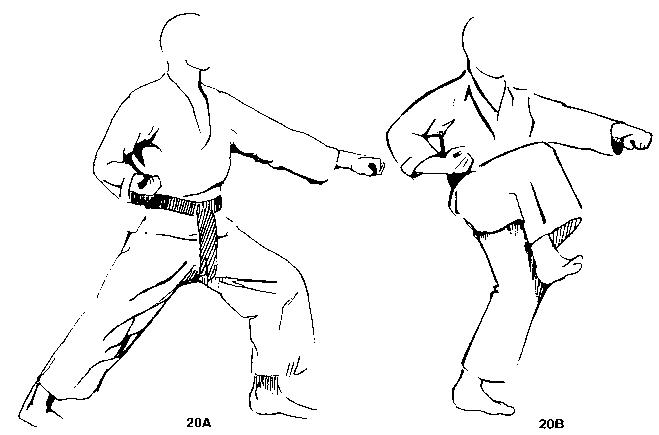
Exercise 20
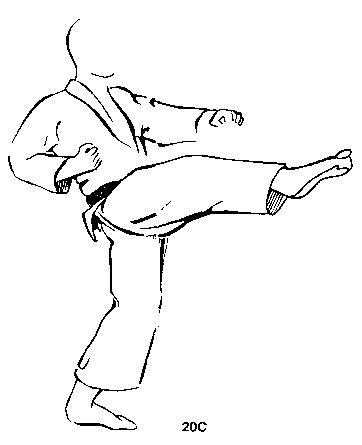
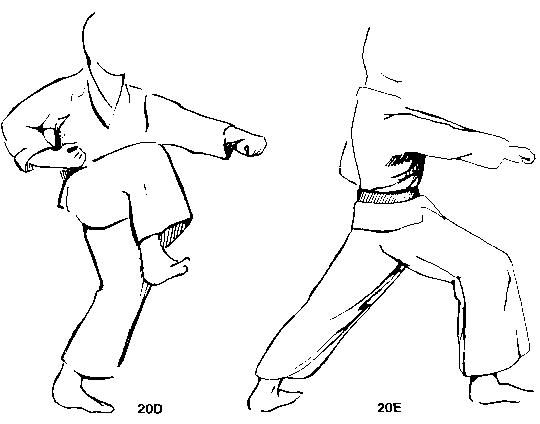
FRONT-THRUST-KICK. To do the front-thrust-kick, first assume front-stance,
left leg forward, with your hips tucked in. (You might want to hold lightly on
to a wall or some other object with one hand for balance when you first
practice kicks.) Then drive your right leg to the target along the line from
your knee through the ball of your foot, using force which comes from your
stance (left) leg through your hip. Then bring your kicking leg back to the
center of your body to allow a smooth transition to step into next stance. Use
your abdominal muscles to control the kicking leg throughout its trajectory;
this allows your leg muscles to be relaxed enough to be most receptive to
momentum from your hip. As with the underarm connection in the punch, there
should be an elastic-feeling connection between your leg and torso. The
connection is minimal at first, allowing the leg to accelerate away from the
hip and attain a high velocity; it is maximum at the focus as it unites the leg
with the more massive torso, supported by the rigid stance leg. (Figures
20A-20E illustrate the front-thrust-kick.)
[Figure 20A-B
Figure 20C
Figure 20D-E]
Exercise 21
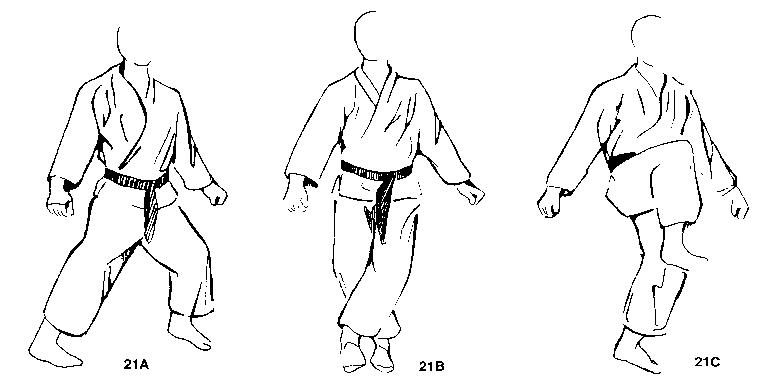
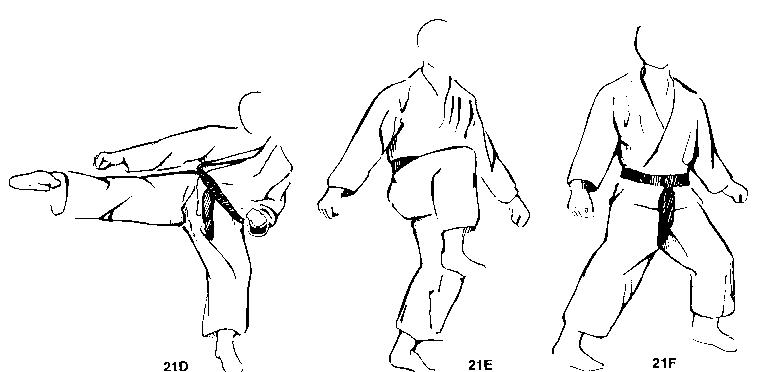
SIDE-THRUST-KICK. To do the side-thrust-kick, drive the leg to target along
the line from the knee through the side edge of your foot with the stance leg
being used as in side-stance to drive the hips sideways. Remember to keep your
hips tucked in just as in the front-thrust-kick. Figures 21A-21F illustrate the
side-thrust-kick.
[Figure 21A-C
Figure 21D-F]
LINEAR SOMATIC CONCENTRATION. As discussed after the introduction of the shifting power method, linear techniques such as thrust kicks provide a simple method of directing body-centered concentration to control an opponent(s) and the external environment.
Exercise 22
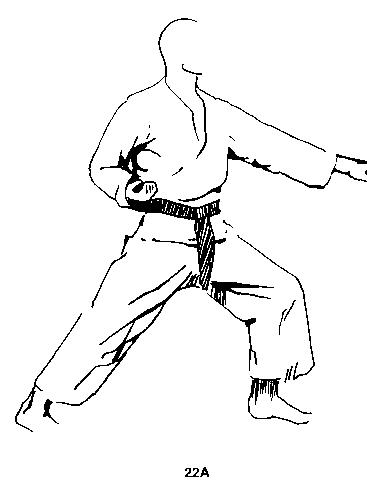
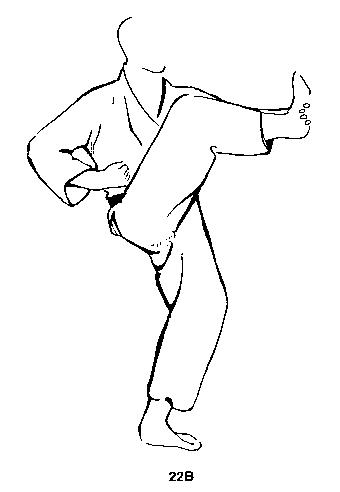
CRESCENT-KICK. Another basic kick that you can practice at this stage is the
crescent-kick. It utilizes hip rotation to swing the sole of the back leg into
the target, which in Figure 22B happens to be the palm of the opposite hand.
[Figure 22A
Figure 22B]
The swinging motion used in the crescent-kick can be applied to the bottom of the calf of the opponent (without smashing the leg, which has the undesirable effect of breaking your own balance and making your partner somewhat angry with you!).
Exercise 23
A good exercise to practice this sweeping motion is for you and an opponent to face each other with opposite feet forward - e.g., one right, one left. Both step back and step in repeatedly until one side takes a chance and tries either to punch to the face or to sweep the opponent's incoming front leg, which may be bracing for a punch. If you successfully execute the sweep, quickly rotate back to execute a counter-punch.
The trajectory of the crescent-kick, similar to the attack- 22A blocks, is curved. The dynamics of curved techniques will be further explored in the next sub-section.
Exercise 24
A simple test may be made to see if the starting motion in the kicks is truly generated from the stance and hips, or if it is generated incorrectly from reaction forces set up by initial muscle activity in the chest and shoulders (a common mistake of beginning students, especially men). In this test keep your arms loosely folded during the kick, and notice any tensions in your chest or shoulders that may impede your motion. If you feel such tensions, you know that aforementioned undesirable reaction forces are present.
If you are a beginner, you should go to Appendix 3 and learn the first kata.
TORQUES AND ANGULAR MOVEMENT. It is now time to study the dynamics of rotation movements in more detail than was done when we discussed the counter-punch, blocking techniques, and the crescent-kick. Many analogies can be made between the dynamics of linear and curvilinear movements. To create linear motion, you applied forces or reaction forces to accelerate the masses of your arms, legs, and body, producing momentum at the target. The momentum '6 you produced continued along its line of motion until it was stopped by forces from another body or by internal forces such as friction. You were also able to transfer momentum from the body to the arms and legs to produce fast-moving projectiles.
'6 F (force) = m (mass) x a (acceleration); v (velocity) imparted to m by F is v = a x t (time). At any time, t, P (momentum) = m x v.
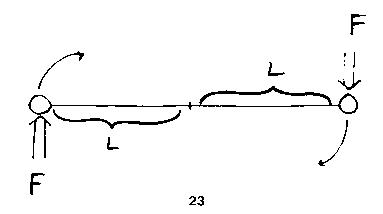
Torque is used in a similar way to accelerate and rotate inertia to produce
angular momentum (a spinning motion).'7 Figure 23 shows equal and opposite
forces, F, acting at the ends of a stick of length 2L, rotating it about its
center.
[Figure 23]
'7 The inertia, I, of a body of mass with respect to a point a distance r away, about which it is rotating, is equal to I = m x r x r. The angular momentum, A, possessed by this rotating mass, is equal to A = m x v X r, where v is the tangential velocity of the mass around the center. The angular velocity, w, is expressed as v/r.
Angular momentum tends to continue its circular motion until stopped by other torques.
Exercise 25
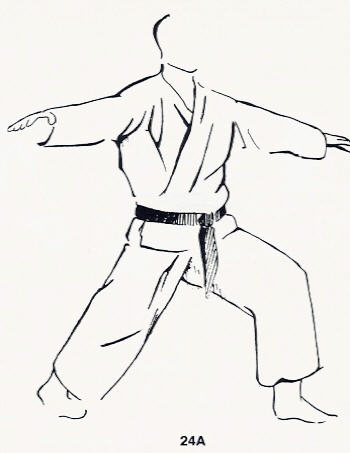
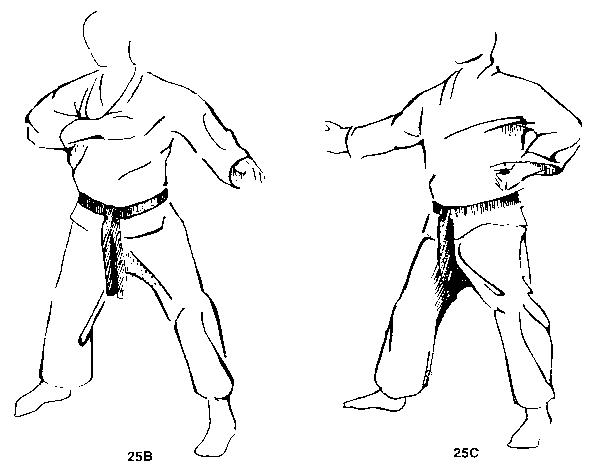
INERTIA. The concept of inertia can be readily understood in body language by performing the following exercise. Assume a front-stance, keeping arms outstretched with underarms tensed so that the arms move rigidly with the hips. Rotate the hips and arms with maximum torque across the hips to cause the hips to rotate. Practice rotating the hips and arms several times (Figure 24A).
Bend the arms at the elbow, and do the same hip motion (Figure 24B). Then do
the movement a third time, clasping your elbows with your hands (Figure 24C).
Now do the first exercise (Figure 24A) once more, and notice how much harder it
is to get up the same angular speed with the first exercise as compared to the
third. In each case the mass moved was the same, but the inertia was different.
[Figure 24A
Figure 24B-C]
Exercise 26
STRIKE-LOCK TECHNIQUES. You can transfer this rotation motion - angular
momentum - to other body parts; this is analogous to transferring linear
momentum from the body to the arm in a step-in-punch. From one back-stance,
rotate 180 degrees to another back-stance, swinging the arm and focusing the
back of the fist on an imaginary target (Figure 25). To get maximum speed,
sweep the elbow across the body, bending it as it crosses through the center,
then letting it whip out to the target. This motion is most efficient because
the inertia is minimized in the middle of the motion by bending the elbow; the
distance from the center of rotation is almost zero, which allows the greatest
speed to be built up for a given torque from the legs and hips. Be sure to
tense the small group of muscles under the arm and on the sides of the ribs to
lock the arm, preventing a rocking motion at focus. This technique feels like a
whip: A large mass (you act as the handle of the whip) starts a rotation
motion; this angular momentum continues to ripple down the whip to the end,
whereupon the small mass (your fist, analogous to the knot of the whip) is
accelerated to very high speeds. This motion is called a strike-lock technique
because, upon focus the arm locks to the body. Whereas thrusting techniques
approach their targets as arrows, striking techniques approach their targets as
swinging sticks.
[Figure 25A
Figure 25B-C]
Exercise 27
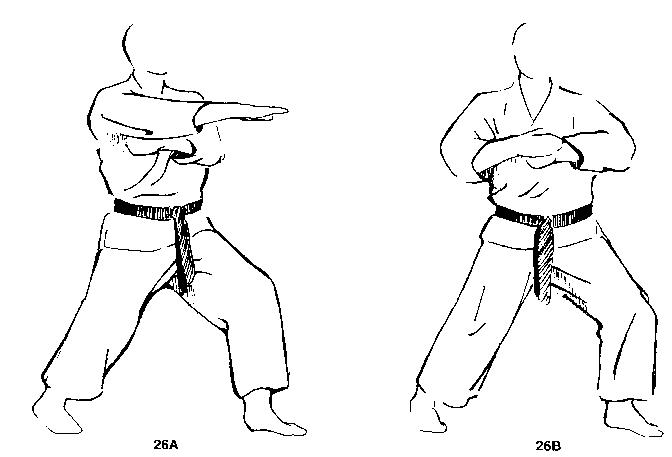
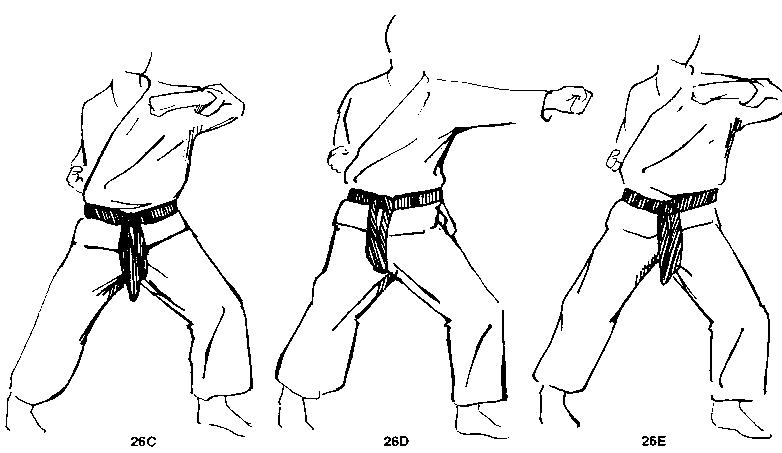
STRIKE-SNAP TECHNIQUES. Another striking technique is the strike-snap motion, so-called because of a snapback, or recoil, movement. For variety, practice this technique with a different method of hip power: By now you are versed in the reverse-rotation-down-block technique that is done, for example, by stepping back from natural-stance to front-stance. Allow your elbow to go straight to a target at face level, rather than down to a block. Your hips rotate in one direction; your arm rotates in the opposite direction (Figure 26). As your hips complete their 45-degree rotation, lock the underarm of your striking an-n to your body but keep your elbow joint rather flexible, maintaining a "spongy" feeling. The dynamics of this "spongy" feeling will be explained later in the section on Energy. The spinning motion given to your arm thus "leaks out" and is transferred to your forearm, which spins out very quickly from the upper-arm-body connected mass and then automatically snaps back close to your upper-arm again, similar to the action of a released, stretched spring. (Actually, the compressed tricep muscles greatly contribute to this recoil upon their expansion.)
Since the inertia of the body is much greater than the inertia of the forearm, we find that (neglecting internal frictional torques) the angular speed of the forearm must be much greater than the original angular speed of the body. Thus you can transform the large inertia of your body into a large angular speed of your forearm.'8 This is quite similar to using the principles of linear momentum applied to many thrusting techniques; for example, a moving body mass can be used to develop fast punches.
'8 The transfer of angular momentum may be algebraically described as
follows: Let the inertias of the body (rotating about the center as in Figure
26A compare to Figure 23), the arm (rotating about the shoulder joint as in
Figure 26B), and the forearm (rotating about the elbow joint as in Figure 26C),
be denoted by I (body), I (arm), and 1 (forearm), respectively. Let the angular
velocity of the body, the arm, and the forearm be denoted by w (body), w (arm),
and w (forearm), respectively. Then conservation of angular momentum A at each
stage, transferred down to the arm by a system of levers, implies that: A = I
(body) x w (body) = I (arm) x w (arm). A = I (arm) x w (arm) = I (forearm) x w
(forearm). Some algebra shows that w (forearm) = [I (body) / I (forearm] x w
(body) Since I (body) is greater than I (forearm), we see that the angular
velocity of the forearm becomes much greater than the angular velocity of the
body (neglecting friction at the joints).
[Figure 26A-B
Figure 26C-E]
Performance of strike-snaps requires a muscular feeling in the joints, which is different from the elastic connection or the swivel joint connection discussed previously. This third connection, a "spongy" connection, requires a muscular rhythm of expansion and contraction paralleling the dynamic motion of the limb to and from the target. (This type of muscle flexibility is also used in the hips and legs and will be elaborated on later in the section dealing with Energy.)
Striking techniques take advantage of the small inertia of the striking
limb. Aside from strategy (choice of technique, timing, and distance), a given
technique can most efficiently transfer momentum when the target and the
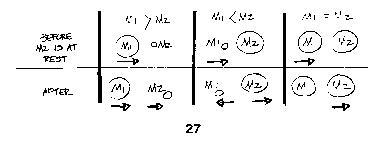
projectile have equal masses. Consider the three cases of a moving marble
hitting another marble at rest in Figure 27, (It is assumed in this simple
discussion that no heat is generated in the collisions; the marbles are
completely ideal and elastic.) Only in the third case, which is familiar to all
those who have played marbles, billiards, or pool, can the momentum of one
marble be completely transferred to the other. With a given momentum available,
the various thrusting and striking techniques give a rather wide range of
masses to use against various targets (face, body, and so forth) in order to
accomplish maximum transfer of momentum.
[Figure 27]
Exercise 28
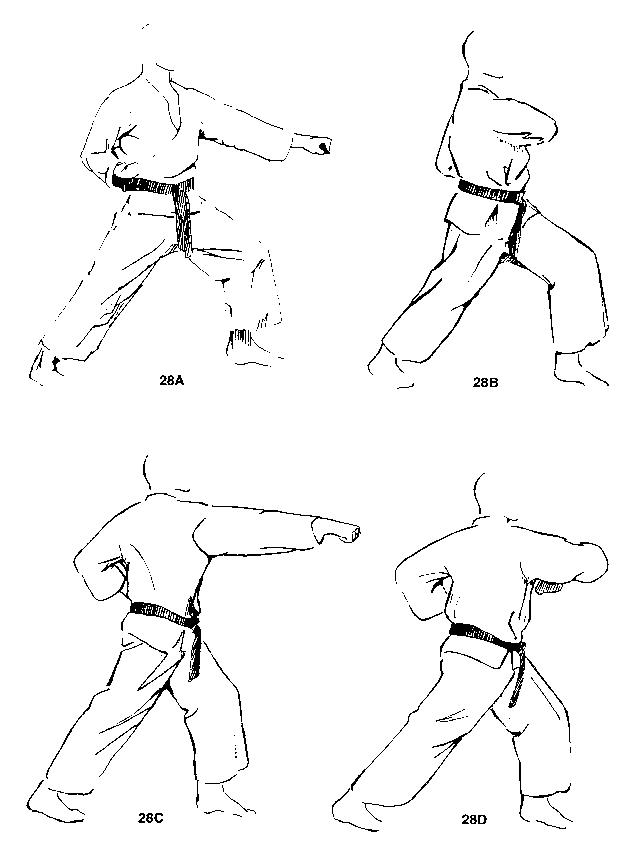
COUNTER STRIKE-SNAP TECHNIQUES. A very sophisticated example of power
control is seen in one of the counter-strike-snap techniques - the
counter-bottom-fist-strike-snap (the meaty part of the fist is usually used
against hard targets) in front-stance with the back arm (Figure 28). Use direct
rotation of the hip to rotate your elbow toward the target (your fist moves to
solar plexus region) as in Figure 28B. As the hip continues to rotate to the
reverse-half-body position, the resulting reverse-rotation motion produces the
proper angular momentum to be transferred to the forearm. Finally the
"sponge-feeling" in the elbow enables you to execute the strike-snap, which has
occurred between Figures 28C and 28D.
[Figure 28A-D]
Exercise 29
STRIKE-LOCK ELBOW ATTACK. To produce a strike-lock elbow attack, go through Exercise 28, keeping your elbow locked and drive it to the target without releasing your fist from the solar plexus region.
Exercise 30
To execute a strike-lock elbow attack to the face, start as in Exercise 29, but swing your elbow directly up to attack the face. The palm side of your fist should finally come close to the ear on the attacking side of the body.
Exercise 31
A reverse-rotation technique may send out yet another type of elbow-striking technique to the target. From round block position in front-stance, move the front leg in to center and then out, changing to side-stance and thereby causing the hips to rotate; this is used to accomplish a reverse-rotation hip motion that drives your elbow out chest level along the line of the original front stance.
ASIDE ON HAND TECHNIQUES FOR STRIKING. For completeness, other hand techniques used for striking are briefly discussed. These, of course, use the principles previously discussed. The practice of these techniques will be done within the context of the Combinations in Appendix 4.
The techniques described in the Additional Aside on Hand Techniques For Blocking can be used for striking. These include: back-fist, bottom-fist, knife-hand, ridge-hand, backhand, open-palm, tiger-paw, chicken-head, tortoise-head (bent-wrist), palm-heel (sometimes called ox-jaw) and Chinese-sword. In addition, the tip of the spear-hand may be used (carefully in practice!) to the eyes. The rising-punch can also be considered a striking hand technique. The thumb-knuckle is made by pressing the thumb against the second knuckle of the forefinger of the clenched fist. The bear-claw is made by bending all the fingers at the second knuckle.
The back-fist-strike (-lock or -snap) is performed as a bottom-fist-strike until just before focus, when the forearm rotates out to execute the back-fist-strike. This is done for the same reasons the punch rotates only just before focus - to minimize tensions across the bicep.
It is often very efficient to smoothly whip back and forth with the same hand, between Chinese-sword and chickenhead, or between tortoise-head and palm-heel, to make useful attack-block or double-attack (block) combinations.
STRIKE-SNAP-KICKS. The line from the solar Plexus to the knee can move in three planes to produce front-thrust (and back-thrust), side-thrust, and crescent kicks. The above striking method also can be applied in these three planes to produce strike-snap kicks, which are referred to as front-snap, side-snap, and round(-snap) kicks. (The crescent kick is more properly classified as a strike-lock technique.)
The dynamics of each kick can be understood on two levels. On one level, the concepts of forces and reaction forces are used to analyze each limb motion as it contributes to the total technique. On the other level, concepts of linear momentum, angular momentum, and energy, discussed in the next section, describe the total process more abstractly, but also easily lead to generalization. An understanding of the second level will enable you to learn all the snap-kicks almost simultaneously, so that you won't need to spend weeks imitating and memorizing a different body feeling for each technique.
Exercise 32
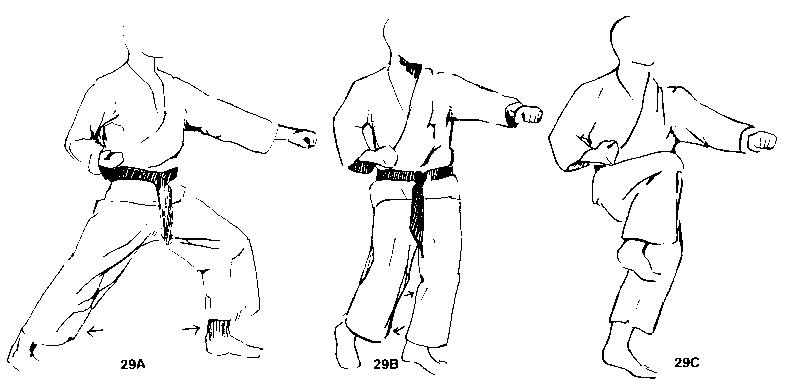
FRONT-SNAP-KICK. The fundamentals of the front-snap-kick are best learned with one hand placed against the wall for balance. The kick is usually delivered with the ball of the foot, although sometimes the toes are turned down to make a "Fist." Though your ankle is rigid upon impact, keep it somewhat flexible during the kick to continuously direct a straight line from your heel through the ball of the foot directly into the target. From front-stance, left leg forward, move the back leg to kick by changing your front leg from pushing out to pulling in, as in the beginning of the step-in-punch. (If not done properly, the shoulders will jerk back involuntarily to cause the reaction force necessary to move the leg. This motion breaks balance and prevents the body from compressing when focusing during impact.)
In executing the snap-kick, you must rotate the line connecting the solar plexus to the knee about the solar plexus as center. Minimize inertia to obtain maximum speed -that is, as your knee progresses toward the target, bend it sharply in order to keep most of your leg close to the center of rotation for as much of the kicking trajectory as possible. This occurs quite naturally as your knee accelerates toward the target; your calf is rotated up to the back of your thigh because of a reaction force that is similar to the one described in the use of the pulling hand for punching and in the reverse-rotation techniques.
Create tension inside curves that run along the inside and top of your thigh
and the abdominal walls to help lock your front leg to your body just when the
line from the center of your hip through your knee is finally pointing to the
target (Figure 29C). Your back leg directs force through this imaginary line,
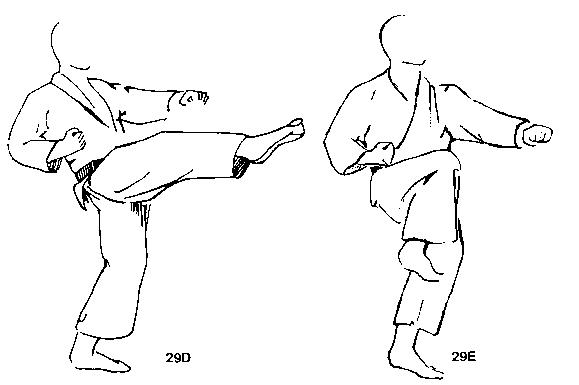
feeling like the back leg of front-stance. If the knee is now kept flexible,
the force that stops the leg motion whips out the foot by effecting a
reverse-rotation force (Figure 29D). Your leg automatically springs back as
your knee assumes the "spongy" feeling similar to that used in the arm
strike-snap techniques (Figure 29E). If the muscular expansion and contraction
of all the body muscles follows the rhythm of this dynamic flow, this kick
becomes a very strong technique. This kind of muscular control will be
discussed further in the section on Energy.
[Figure 29A-C
Figure 29D-E]
In thrusting techniques, the body is rigid and mostly Compressed upon focus. In striking techniques, the body first has an overall stretched feeling that helps to connect the back stance leg through the attacking hand or foot much the same way two ends of a taut string are connected. The hip and abdominal regions then compress with the snap-back of the technique. In all techniques some method of total body connection is necessary.
A more general way of looking at the snap-kick technique is to observe that a torque from the original front-stance produces a spinning movement using the line from the solar plexus to the knee as the radius of the circular motion. This angular momentum is then transferred to the lower leg when the stance (standing) leg acting at the solar plexus exerts a counter-torque to still the body.
Exercise 33
SIDE-SNAP-KICK. The same dynamic process can produce a side-snap-kick to attack a target to the side, using the outside edge of the foot. Be careful not to turn the toes and ankle out; if you do, your thigh muscles also will twist out. From the point of view of forces (reverse-rotation), the bottom of your leg is scooped up towards the groin as your knee shoots out. Your knee should be out at an angle of about 45 degrees from the front of the body rather than to the center as in the side-thrust-kick. When your thigh is then locked, making I it a rigid extension of the torso, the spinning motion originally generated in the torso and leg is transferred to the lower leg.
If you had maximum speed at the target, your leg should quickly snap back to
a position close to the thigh (Figure 30E), utilizing the "spongy" feeling at
the knee.
[Figure 30A-C
Figure 30D-E]
Exercise 34
ROUND-KICK. The round-kick is done in the third plane (horizontal) of your
three-dimensional space. The kicking leg essentially does the front-snap-kick,
but in the horizontal plane. Use your side muscles to help pick up the leg so
that your heel, ball of your foot, knee, and hip are equal distances from the
ground. Rotate your hip and knee 90 degrees, so that the bottom of your leg is
driven to the back of the thigh; lock your knee and hip along the line to the
target to spin off your lower leg. As with the other snap kicks, it is easy to
step smoothly into the next stance and technique (Figure 31).
[Figure 31A-B
Figure 31C-D]
Exercises 35 & 36
FRONT-KNEE AND ROUND-KNEE KICKS. If the knee is held rigidly bent, instead of sponge-like, when doing the front and round kicks, front-knee and round-knee striking attacks are performed.
Beginners often persist in confusing the thrust-kicks and snap-kicks. Remember that, in the thrust-kicks, the line from the knee to the bottom of the foot starts at the solar plexus; then the knee is driven along this line into the target. In the snap-kicks, the knee is rotated up to the kicking position where it momentarily stops allowing the bottom of the leg to carry the angular momentum to the target. An effective snap-kick will also carry some linear momentum to the target, but along the line connecting the hip-center, knee and target, without allowing the knee to rotate away from this line during the snapping technique. This linear component of momentum aids the control as well as the power of the kick.
REMINDER: You should be practicing all these techniques in the context of two- to four-step combinations as well as keeping up with the practice of the kata (Appendix 3).
ASIDE ON KICKING. For completeness, the other kicks are briefly discussed. The practice of these techniques, utilizing the above principles, will be done within the context of the Combinations of Appendix 4.
The inside-round-kick starts as a front-kick, but the hip-center curves the knee and kicks to the comer outside the same side as the kicking leg. The round-front-kick is performed in the 45 degree plane, half-way between the planes of the front and round kicks. To develop maximum power, caution must be taken with the back-thrust-kick to ensure that the stance leg is used as the front leg of front-stance; the hips should be tucked in as much as possible, yet allowing a gentle curve in the back concave towards the target. The back-snap-kick whips the heel of the foot to the target by a sudden tensing of the leg bicep. The wheel-kick is performed by rotating the slightly curved leg to attack the target with the back of the heel; there is a slight contraction of the leg bicep on focus, similar to the back-snap-kick. This kick can be performed with either direct rotation or reverse-rotation (sometimes called inside-wheel-kick) hip-leg dynamics. The stomp-kick (or the stamp-kick) is performed as a side-thrust-kick, but is directed down to the ground. This kick may be executed close to the other leg, or at side-stance distance; if the latter is done correctly, the knee must move in a smooth arc from the center of the hip, over towards the target, then down to the target.
The leg can be used for sweeping motions in several ways. The crescent-sweep-kick can be delivered to the ankle, calf, or knee with either direct-rotation or reverse-rotation hip-leg dynamics. The hook-sweep-kick pulls the foot (with its target) towards your body center just as contact is made. The wheel-sweep-kick is performed like the wheel-kick, but close to the ground.
The leg can also be used for blocks. Most often used are the crescent-kick-block and the inside-snap-kick-block. The latter is accomplished by using the inside thigh muscles of the stance leg to pull the sole of the kicking leg upwards towards the center of your body.
Many of the kicks can be performed while jumping. Some of the most popular are the flying-front-kick, flying-side-thrust (or snap)-kick, flying-double-front-kick (legs used alternately), and the flying-front & side (snap or thrust)-kick (legs used alternately).
APPLICATION TO BODY MOVEMENTS. Some of the principles described above can be
utilized to effect dynamic rotational and sidewards body motion. In the next
three exercises start from a partially relaxed front-stance, which is a natural
sparring stance. In both rotational and sidewards motion, the smaller lateral
components of the forces between the legs are used.
[Figure 32]
Exercise 37
CIRCLE-SHIFTING is accomplished by rotating the body, using the front leg as
a pivot. The pivot leg changes its lateral component of force from outward to
inward, which enables both legs to forcibly rotate the body. As your back leg
rotates around, allow the inside thigh muscles that are pulling on the inside
of your front leg to connect and pull along the inside thigh muscles of your
back leg; this will pull your legs together during the rotation, minimizing
their inertia and maximally accelerating the turn (Figure 33).
[Figure 33A-C]
Exercise 38
SIDE-SHIFTING is accomplished by releasing the horizontal force on the back
leg to allow a sidewards motion to begin. Bring your back leg through the
center of the body, and drive it back along a 90-degree axis. Push your front
leg outward along the floor to the side; it now becomes the front leg of a
front-stance at the new 90-degree angle (Figure 34).
[Figure 34A
Figure 34B-C]
Exercise 39
The front leg can also twist and reverse-rotate the hip. If a down-block is to be performed, the hip, in turn, reverse-rotates the arm. Side-shifting to a down-block position thus utilizes an aesthetic unity of many dynamic processes.
If you are a beginner, you should now begin learning Combinations. Appendix 4 will give you enough for your first year. (A good instructor will already be making up two- to four-step combinations for basic practice and sparring.)
FALLS. You can experience the sensation of complete body rotation in tumbling, which a few methods of falling will illustrate. In every fall, the spine is kept smoothly curved by tucking in the pelvis, tucking in the chin, and maintaining an even tension along the curved spine. The purpose is to convert some of the energy gained in the fall into harmless, rolling, rotational energy.
In the counter-punching and blocking techniques performed early in this training, the torso made turning motions similar to motions in the falls, but the movement was accomplished by using the legs to torque the torso. By utilizing gravity to perform these falls, you can better realize a more total three-dimensionality to all techniques. Learning to fall is, of course, essential before seriously practicing leg sweeps (variations of crescent kicking) and throws (discussed after falls).
Exercise 40
The backward-fall is performed by simultaneously squatting and rolling back.
As the roll begins, the arms, which are extended at a 45-degree angle out from
the sides, slap the floor to help break the backward fall (Figure 35).
[Figure 35A-C]
Exercise 41
Use the curved spine as a cradle to perform the side-roll. Both arms and
your bent leg cushion the roll (Figure 36).
[Figure 36A-C]
Exercise 42
Perform the forward-roll by rolling diagonally across your curved back and
hip. Curve your arms and hands as extensions of your spine as your body falls
forward and over across the back hip (Figure 37).
[Figure 37A-C]
THROWS. A category of techniques that demand smooth, correct torquing motions includes throws and joint-twisting techniques. One's opponent as well as oneself must be controlled in the rotation movements.'9
'9 In all exercises involving two or more people, work with your opponent so that you both learn from the activity. The object is not to hurt each other. All such exercises should be done slowly for the first few trials.
Exercise 43
Person A (offense) steps-in and punches at stomach level; Person B (defense)
shifts to the opponent's inside and blocks with knife-hand-block in back-stance
(Figures 38A-38B). Person B quickly shifts to front-stance and thrusts the
other arm, using the knife-hand (open but tensed palm) under the underarm of
the attacker (Figure 38C). >From this position, Person B can throw Person A
by smoothly rotating the coupled bodies, with arms extended, 180 degrees to a
new front-stance (Figure 38D). The erect posture and straight eye positions are
extremely important in this exercise.
[Figure 38A-D]
Exercise 44
Another throw can be performed against an opponent who is
front-thrust-kicking. The defender slides inside Person A's kicking leg,
thrusting the closer hand inside the thigh and the other hand across the neck
(Figures 39A-39B), then turns 180 degrees to the new front-stance to throw
Person A (Figure 39C). If you are the thrower, help the opponent to roll by
tucking his/her head under as you throw him/her.
[Figure 39A-C]
CURVILINEAR SOMATIC CONCENTRATION. As discussed after blocking and just before thrust-kicking, curvilinear arm, leg, and body techniques provide an important method of directing body-centered concentration to control an opponents) and the external environment.
C.Energy and Expanded Body Awareness
Energy, another physical principle commonly applied to karate techniques, is composed of three forms: Energy (total) = Energy (motion)'1O + Energy (compression) + Energy (heat).
'10 Energy (motion) = [(momentum) x (momentum)] / (2 x mass)
Energy (heat) is caused by friction in the muscles, biochemical processes, and so forth; it cannot be practically retrieved. Energy (compression) from compressed muscles can be reused to produce the beginning of another technique much the same as motion can be obtained from a compressed spring or sponge-ball.
Exercise 45
This principle is primarily responsible for the smooth flow between the two techniques in the simple exercise: counter-punch, and step-in counter-punch off the compression from the first technique. The expansion from the first counter-punch not only helps the torso prepare for the next compression (second counter-punch), but also puts extra tension across the stance which is used to quickly step forward by initially pulling in with the front leg.
The use of this muscular compression and expansion in the arms and legs gives rise to the "spongy" feeling necessary to do the strike-snap techniques discussed in the previous section. Now we are applying this feeling to the entire body.
Body rhythm is often aided by knowing and using physical laws of force, energy, and motion. The momentum created for one technique can serve the next technique as well:
Exercise 46
In performing the combination of step-in front-snap-kick, then punch, the body momentum gathered behind the kick continues forward, increasing the effectiveness of the punch.
Exercise 47
In order to smoothly integrate individual techniques into combinations as well as to perfect each technique, body expansion and compression must be learned. A simple exercise taken from the kata '11 illustrates the possibilities of such technique-to-technique connections. Try 3 successive step-in-punches. After the first punch, wait until the body springs back to the neutral state (or state of even tonus) before triggering the start of the second punch. Although the momentum of the body stops after the first punch, the inside muscular expansion and compression continues. After the second punch however, continue momentum and also use the compression of that punch to trigger the start of the third punch. Between these last two punches both the outside and inside movements of the body are uninterrupted. The total count is: 1, 2-3.
'11 See Appendix 3.
Exercise 48
Apply the rhythm of 1, 2-3 to: step-back down-block (1), waiting until the neutral position is attained, and step-in-kick (2), and punch (3).
Exercise 49
The count 1-2-3 can be used in the following exercise: step back up-block, front leg front-kick, then step-in-punch (no internal pauses).
In the following two exercises synchronize the feelings of internal body flexibility with external movement:
Exercise 50
With Linear Motion: Step in front-snap-kick, step into punch, front leg front-snap-kick, snap-back and step back to reverse-rotation-punch.
Exercise 51
With Circular Motion: Starting from counter-punch position, step in round-kick, step into counter-punch, step back and round-block (same hand that punched), front leg round-kick, and counter-punch.
ENERGY AND EXPANDED SOMATIC AWARENESS. The awareness of using energy of body compression and expansion is a completely different attention state than that used to direct linear or curvilinear body-centered concentration to a target. This new state of attention requires a full awareness of the body rhythm necessary to produce any single body technique as well as to smoothly fill and connect the spaces between techniques. No matter how fast you accomplish single techniques or their connections, maximum power is only developed by studying the smooth flow that takes place even on these shortest time scales. This somatic awareness will be seen to have auditory and visual counterparts in Chapter 3.
FOCUS. Up to this point we have treated the vast subject of body dynamics in terms of a small number of basic processes - forces, momentum, energy. Now treatment will be expanded on a single activity, somatic focus, which is the maximization of momentum during the small space-time interval of impact.
Exercise 52
In order to have a relative gauge of your timing and speed, use a time interval of two to four heart beats, within which to trigger a technique - counter-punch or front kick, for example. Try to minimize the time span between being aware of triggering yourself to execute the movement and actually making the movement. As you become aware of more and more centeredness and unity in a single movement, your concept of time duration will expand. If you sense that your technique is becoming faster with practice, almost certainly you are correct.
Exercise 53
To gauge your mass (body connection, stance, etc.), punch within 1/8 of an inch from a wall, then relax the front leg, allow the body to drive against the wall, and check if the mass connection flows correctly through your body. You should feel a smooth line of tension between your fist and the bottom of your back foot. Try to achieve a stronger mass connection on the next punch, and so on.
Exercise 54
Do a similar set of exercises for thrust-kicking as for the punch (Exercises 52 and 53).
Exercise 55
The next step is to smoothly connect the initial body dynamics - the production of high speeds - with the final body connection - the attaching of the large body mass to the fast projectile. This will be practiced as you counter-punch, using breathing and body dynamics correctly. During the initial stages of the technique, begin to compress your body and accelerate your arm, utilizing the minimum connection under your arm necessary to attach it to your body. Continue to accelerate your arm during the middle stages of the techniques as your body further compresses; the elastic connection becomes stronger. This compression is accomplished by strongly exhaling, which helps to unify the large muscles of the body. Finally, the last stage of the technique is marked by an intense total body compression as you accelerate the punch up to maximum velocity, yet rigidly connect your arm to your body.
Exercise 56
To help maximize the momentum within the shortest time interval, do the techniques with a strong Kiai. This helps to erase many psychological traps which can prevent you from centering your energy.
Two important time intervals involved in focus are the time from the beginning of the technique up to the focus, and that during focus:
Exercise 57
The importance of the first time interval can be demonstrated with a simple punching technique. The time interval between the beginning of the punch and the beginning of body focus is longer, respectively, when punching using side-stance with body vibration, when punching using front-stance with body rotation, and when punching using front-stance to shift into a new front-stance. Try all three alternately, to develop an awareness of the different time scales of focus.
Exercise 58
During focus of punching and strike-snapping, the body feeling is quite different and has correspondingly different time intervals. During the punch, which is a thrusting technique, the body is compressed. During a back-hand strike-snap technique, the body passes through a completely stretched position during impact and then compresses towards the center as the arm recoils back, which actually aids the arm's recoil movement. Hand and leg techniques as well as striking and thrusting techniques also have different time intervals during focus. The difference is easily noted by comparing a front-snap-kick to a step-in-punch to a front-thrust-kick and so forth. A methodical procedure to analyze these differences is to alternately pair a counter-punch with other techniques such as another punch, a strike-block technique, a hand-strike-snap technique, a front-snap-kick, a side-thrust-kick. The counter-punch serves as a standard to compare these other techniques.
A fine sense of focus and self-body-control is essential before sparring. Self-mental-control is obviously also essential; this will be elaborated on in the next two chapters. However, even at this stage, simple pre-planned sparring exercises can give you invaluable feedback on your own techniques and rhythm, as well as prepare you to engage with an opponent's techniques and rhythms. Free-sparring, without preset techniques, should only be practiced under the strict supervision of a competent Instructor.
DEFENSE-ATTACK SEQUENCES. Sparring exercises can be done emphasizing a competition of attacking and defense rhythms. Do these exercises slowly the first few times. Just touch, don't hit (focus inside) the other person's body. "To the face" means almost touching the face (1/8 of an inch away).
In the following two exercises, both opponents start with left leg forward in down-block position, far enough apart so your fists cannot touch.
Exercise 59
Attack: step-in double-punch to the face (one step forward, two punches).
Defense: step back, up-block to the first punch, and counter-punch to stomach (solar plexus). Both sides complete to execute their second punch first.
Exercise 60
Attack: step-in front-snap-kick, continue to step-in-punch to the face.
Defense: step to the side and take a front-stance facing 90 degrees away from the opponent's kick down-blocking, and then turn and lunge towards the attacker, counter-punching to the solar plexus.
Summary
Section A discussed the application of forces and torques to develop stance; this involves somatic (body) concentration to one's own body-center.
Section B discussed the application of linear and angular momentum to develop punches, blocks, hand-strikes, and thrusting and snapping kicks; this involves linear and curvilinear directional control of somatic concentration along a line and to angles.
Section C discussed the application of energy to develop rhythm, and body expansion and compression; this involves expanded somatic awareness.
CHAPTER 2
Sensory Nature
The purpose of this book is to illustrate how the practice of karate can be a useful tool to study many of the physical and mental processes necessary to learn and be creative in all facets of life. The "correct" or "ideal" mental processes are perhaps the most perplexing part of karate study.
It is especially important for the new student to realize that, independent of motives and attitudes, there are precise attention states that must be mastered in order to function at a creative level. A mastery of these attention states will enable you to many times bypass emotional blocks - anger, fear, frustration, etc. - simply because these emotions become unnecessary to function. Other times, a mastery of these attention states will make it very apparent which desirable emotions - "spirit," motivation, confidence, sharing with your training partner, etc. - are important for you to better yourself and to help others.
This chapter's main purpose is to define and explain these various states of attention. In the next chapter, exercises specific to karate will make these definitions and explanations more relevant and practical.
If this chapter looks too difficult or technical, please skip it on the first reading of this book, and directly proceed to Chapter 3.
A. Sensory Attention
Every physical activity requires good timing; this implies that there is synchronization of awareness of the movements of the opponent with techniques accurately concentrated to specific space-time points; this activity enables you to interact with, and sometimes control, the opponent. In some physical activities - skiing, surfing, driving a car - the "opponent" may be, or also include, the external environment.
A symbolic equation defining Sensory Nature can be inferred from this activity: Sensory Nature: Timing = Focal-Synchro-Plenum (2-1) These terms will be defined and explained in the sections below.
FOCAL MODE. The Focal Mode,'1 basic to consciousness at all levels, is essentially concentration - or attention to a point. In karate, it is manifested in the maximization of momentum during the small space-time interval of impact during a block, punch, strike, or kick. All athletes, amateur or professional, are concerned with increasing their ability to concentrate.
'1 Focal Mode - Focal adj.: of, relating to, or having a focus. Focal n: a central point at a: a center, activity or attraction, or one drawing the greatest attention or interest; b: a point of concentration or of emanation; c: one aspect or area (of a culture) that is more complex and extensively elaborated than others. Definitions are from Webster's Third New International Dictionary, Springfield, Mass., G. & C. Merriam Co., 1971.
PLENUM MODE. The Plenum Mode '2 also basic to all consciousness, is usually a state of diffuse attention, a gestalt feeling for the whole. In physical disciplines, it is a state of awareness, the receptive process of being open to all information, a diffuse attention over a wide region of space-time.
'2 Plenum Mode - Plenum adj.: relating to or being a space in which a plenum exists. Plenum n: the entire membership of a specific group; the quality or state of being full. Definitions from Webster's, ibid.
The Plenum Mode, awareness, involves being sensitive to all that is "relevant" in the external environment. (Relevancy. therefore may also necessitate some interplay with the Focal Mode.) It is an intense state of sensation and perception. The person engaged in any physical discipline should also be aware of and receptive to everything relevant in the internal environment - memory, thought, imagination, intuition, and so on. A Mirror Principle can be stated which expresses the reflexive nature of experience: Experience Mirrors External Environment + Internal Environment (2-2) In karate, kata (formal combinations of techniques) and combinations (sequences of techniques to be quickly learned) are especially useful in becoming aware of internal experiences. If you have high standards, you will set up near perfect sources of energy or imaginary opponents in real external space-time. These sources are endowed with momentum-energy rhythms created by your imagination. When done properly, the combinations can become one of the most important exercises in karate training.
Defense and Attack. Much can be learned from the ancient dance-like sequences in the kata. These kata were composed by masters with forty or sixty years of training both sides of their bodies symmetrically and, I must assume, they therefore utilized their most natural, fluent patterns. However, when studying the katas, I was interested to note that the most natural movements acquired from the masters' symmetrically practiced basic exercises were incorporated asymmetrically into the katas.
In a sparring situation, whether real or imaginary, I hypothesize that you can respond most naturally when you maintain an open state of awareness to your opponent's rhythms - the essence of defense, yet actively poised to concentrate an attack or counter-attack. After analyzing 23 elementary and advanced kata, each of which contains five to ten sub-combinations of defense and attack, I have found that 75% of the sub-combinations start with defense to the left followed by an attack with the right side of the body, or with an initial attack to the right. These initial attack or defense-attack sequences are subsequently performed in mirror image in 50% of the sub-combinations (the defense-attack and its mirror image count as one sub-combination). The conclusion is that, for a right-handed person, the left side is best suited for defense (awareness - Plenum Mode), and the right side is best suited for a subsequent counterattack (concentrated action - Focal Mode,). Now, some years after I made this discovery, a wealth of medical and neurophysiological data reinforces my findings.'3
'3 R. A. Filbey and M. S. Gazzaniga, "Splitting the normal brain with reaction time," Psychonomic Science, 17:335-336, 1969. See Appendix 1, A. A. R. Gibson, R. A. Filbey, M. S. Gazzaniga, "Hemispheric differences as reflected by reaction time," Fed. Proc. 29: 658, 1970. See Appendix 1, B. M. S. Gazzaniga, "Processing of information by name: differences between right and left hemispheres in non-normal man," XIX International Conference of Psychology, 1969. See Appendix 1, C. These three studies support the concept of the subsequent nature of defense-attack in terms of how the brain responds.
SYNCHRO MODE. The Synchro Mode,'4 which joins together the other consciousness processes, is itself the process of interplay between the other modes.
'4 Synchro Mode - Synchro - comb form: synchronized: synchronous. Synchronize vb.: to represent or arrange (events) so as to indicate coincidence or coexistence. Definitions from Webster's, op. cit.
In most right-handed people, the left hemisphere of the brain mainly coordinates the right side of the body, and the right hemisphere of the brain mainly coordinates the left side of the body.'5 (The reverse is true for most left-handed people.) "Mainly" only means with a high degree of correlation, as yet unspecified. This anatomical information leads to a tentative conclusion that the right hemisphere of the brain, mainly controlling the left side of the body, is most naturally used passively to receive the peripheral visual information of space time (Plenum Mode), and the left hemisphere, mainly controlling the right side of the body, is most naturally used to execute an auditory-to-body attack response to a specific point in space-time processed by the cerebellum (hind brain)'6 Information passes from one hemisphere to the other through a bundle of ganglia called the corpus callosum (and perhaps through other parts of the brain), an anatomical connection which helps the brain stem (reticular activating system) to facilitate the Synchro Mode. It is important to realize that these anatomical parts of the brain are correlates of the Synchro Mode which process it; they do not comprise it.
'5 J. Levy, and T. Nagylaki, "A model for the genetics of handedness," Genetics 72:117-118, 1972. See Appendix 1, D. R. W. Sperry, "Lateral Specialization in the Surgically Separated Hemispheres," The Neurosciences: Third Study Program, Cambridge, Massachusetts Institute of Technology, 1974.
'6 H. H. Kornhuber, "Neurologie des kleinhirns," Zbl. Ges. Neurol. Psvchiat. 191:13, 1968. See Appendix 1, F.
For simple tasks, the Synchro Mode controls just a single interplay. In more complex activities (and most activities are complex), information may be coming into both hemispheres and may be transmitted from one to the other more than once. It is probable that the most efficient procedure of processing enables information to go as packages from one hemisphere to the other.'7
'7 Donald E. Broadbent, "Division of function and integration of behavior," The Neurosciences: Third Study Program, Massachusetts Institute of technology, 1974. See Appendix 1, G.
B. Timing = Focal-Synchro-Plenum
The standard teaching methods for karate omit exercises that deal specifically with attention, particularly the Plenum and Synchro Modes. The way attention is usually learned, however, can be understood from the above equation (2-1): Concentration of momentum and energy to specific space-time points (Focal Mode) is always practiced, and immediate somatic feedback of this focus is received from each technique. Sparring provides a sure, if not painful, feedback on timing. By studying two of the variables - Timing (the activity) and Focal Mode concentration - you gradually and indirectly learn the third and fourth variables - Plenum Mode awareness of your opponent's space-time region by use of the Synchro Mode.
You will obviously be able to spar better by synchronizing the Focal and Plenum Mode processes efficiently, rather than by trying to consider the multitudinous possibilities of attack (concentrated action) and defense (awareness), anxiously sliding back and forth between the alternative possibilities. The more efficient the patterning (Plenum Mode) and synchronization become, the less conscious you need be of the total activity.
Thinking is covert action and usually interferes with overt motion. In many body disciplines, experts appear to be moving magically without effort, to float, to have an aura about them; this is particularly apparent in such activities as karate and ballet. What they are merely (!) doing is moving spontaneously, which is a single Focal-Synchro-Plenum sequence, instead of effecting Focal-Synchro-Plenum by several journeys between these modes. Each journey to the Focal Mode has its verbal and somatic correlates; these take time to process, and have (almost) subliminal body responses causing lack of spontaneity in the beginner's movements.
The Focal Mode synchronizes with the Plenum Mode in such a way that the functions of the Plenum Mode are narrowed to a certain range of patterns to be admitted. For example, when facing two opponents in karate, the Plenum Mode covers both opponents; then when one opponent attacks, the Plenum Mode is more attentive to that opponent, but still keeps track of the other opponent in the periphery. Again a further focusing of the Plenum Mode may take place when you are specifically blocking or counter-attacking. The somatic '8 (body) attention should center in on the patterns which are being visually, sometimes auditorily, experienced by the Plenum Mode. The focus within the Plenum Mode is much sharper and more directed than the Plenum Mode field. If the somatic attention (Focal Mode) does not focus within the field of the Plenum Mode, the phenomenon of "clumsiness" is observed. For example, to make an effective hit in tennis, the body attention must be honed down to an even smaller volume within the ball that the Plenum Mode (eye) sees.
'8 In the somatic (body) system, there are three subsystems: (1) the interreceptive nervous system going to the viscera; (2) the proprioceptive system going to the skeletal frame; (3) the exteroceptive system pointing to the outside world.
TIME SCALES IN FOCAL-SYNCHRO-PLENUM. The eye normally vibrates about 20 times per second - in movements defined as saccades - to look at several positions of an object to establish accurate details. To ascertain discrete details from a large field, this use of central vision could take many saccades - more time than for a simple reflex to a pattern perceived as a whole. Also, an object's motion is processed more quickly and accurately by the peripheral vision. Thus, optimum reflex time is attained by reacting to peripheral stimuli within several saccades. Stimulus-response time to a real opponent is also determined by the use of visual memory. The storage of long-term memories (on the order of several seconds) depends on the use and synthesis of images; short-term memories (on the order of a second) involve the use of some scheme or strategy - this process is most often used by beginners in karate; representational memory (on the order of tenths of a second or a few seconds) more directly processes the perceived object.'9 This last type of memory, requiring only a few saccades - more properly classified as a sensation seems to be optimum for most physical activity. You can learn to respond directly to a simple pattern of stimuli without going through any logic or strategy involving several journeys through Focal-Synchro-Plenum.
'9 It has been experimentally verified that visual information is processed in several ways simultaneously. A motor response to an incomplete pattern analysis can often be made. See Fehrer & Biedleman, "A Comparison of Reaction Time and Verbal Report in the Detection of Masked Stimuti," in Ulric Neisser, Cognitive Psychology, New York, Appleton, Century, Croft, 1962.
In sparring, where reflexes are on the order of tenths of a second, all good karateists are ambidextrous. The body language of karate, as is true of all languages, needs distance and time in which to communicate, to allow the FocalSynchro-Plenum process to function. However, in practicing kata, against more "perfect" imaginary opponents, a master might find it necessary to be sensitive to time scales on the order of hundredths of a second. The neurophysiological studies observed in Appendix 1 support this time scale as the lowest threshold for communication between the left and right hemispheres, or for a single Focal-Synchro-Plenum process to take place.'10
'10 See footnote 3.
Appendix 5 contains some ISA Problems. These problems illustrate Focal-Synchro-Plenum on the written page, sometimes describing body activity, sometimes representing these processes more abstractly. As part of the mental training of ISA Karate Instructors, they must regularly create such problems.
The interplay of an Affective Mode (emotions, attitudes, etc.) with Focal-Synchro-Plenum, that tempers and modulates these attention states, is necessary to define and explain a complete psychology of the person and of society. Since this greatly enlarged study is not directly related to karate practice, it is left for another book.'11
'11 Lester Ingber, Principles of nature.
CHAPTER 3
Sensory Nature Applied to Karate
A. Attention Exercises - Body, Visual, Auditory
The following exercises and their obvious generalizations are suggested for practice to increase your familiarity with concentration attention to a point, Focal Mode - and awareness - diffuse attention all over, Plenum Mode - and the ways in which they are integrated Synchro Mode.'1 Examples show how these processes operate in the visual, auditory, and somatic sensory systems.
'1 These Modes were defined and explained in Chapter 2: Focal Mode - Focal adj.: of, relating to, or having a focus. Focal n: a central point at a: a center, activity or attraction, or one drawing the greatest attention or interest; b: a point of concentration or of emanation; c: one aspect or area (of a culture) that is more complex and extensively elaborated than others. Synchro Mode - Synchro - comb. form: synchronized: synchronous. Synchronize vb.: to represent or arrange (events) so as to indicate coincidence or coexistence. Plenum Mode - Plenum adj.: relating to or being a space in which a plenum exists. Plenum n: the entire membership of a specific group; the quality or state of being full.
FOCAL MODE. Somatic concentration of the entire body to a point (the target) is most frequently practiced in karate because it is the essence of "focus." Admittedly, it is one of the hardest exercises to do as it frequently involves an "all-or-nothing" feeling.
Exercise 1
To help separate some of the variables involved, step-in-punch in a straight line towards an opponent who is steadily drifting away, moving from side to side. Keep your eyes fixed on the opponent so that your visual attention is occupied, and try to retain a sense of concentration on the most centered feeling in your hips that you are capable of.
In karate, hip-centeredness is essential to develop strong body techniques as well as to facilitate correct mental activity. You should strive to become aware that your hips, especially as centered about a point midway on the diagonal line that connects the navel to the tailbone, comprise your motor center. Accordingly, as you become more proficient, you will find that your body acquires a "will" of its own, and you won't need to rely on much conscious activity to support its actions. This will free your mind, facilitated by your other sensory systems, to engage in strategy.
Exercise 2
Concentration to a point using the auditory sense also is an "all-or-nothing" matter. You can do a simple exercise to get immediate feedback on whether the process is present. Have your partner count sharply, each count a command to punch while you execute the proper technique. When you are punching, imagine that the sound coming from the voice into your ear takes two neurological paths: One path goes to the brain to tell you that a sound has been received; the other path triggers a body reflex to start the technique. If the exercise is done correctly, you will find yourself moving at the same time you become aware of the sound, not afterwards. Especially if you are a beginner, you will find that you perform the technique more smoothly and dynamically than you did previously - that, indeed, the reaction feels more natural and instinctual.
Exercise 3
Another simple exercise is the visual counterpart of Exercise 2. Two people face each other in front stance, same leg forward, in position to counter-punch in parallel lines to each other's opposite side. Person A counts, and it is prearranged that between two to four heartbeats after this count, Person B counter-punches Person A; at that time, Person A attempts to counter-punch Person B. It is often possible for both people to be counter-punching at the same time. If done correctly, Person A perceives Person B's motion simultaneously as he/she feels his/her own punch for reasons that are similar to the ones given in the auditory exercise above.
PLENUM MODE. In any physical activity it is important to develop a sense of diffuse pattern attention, or awareness, in which complex movements are perceived as whole units. This sense of awareness is essential to attain a mastery of rhythm and timing. The next series of exercises serves to develop such a sense of awareness (Plenum Mode).
Exercise 4
The first exercise is designed to develop a holistic, somatic sense of body rhythm. The best time to begin a technique depends on the demands of the situation. However, there are two optimal states from which the body is best prepared to move. One state, called the neutral, or natural, state is a state of body tonus with a readiness to move in any direction. The major muscle groups are neither fully stretched nor compressed, but are prepared to expand or contract, depending on the need. The other state originates from a state of maximal compression or expansion, typically caused by the completion of a previous technique. For example, from a natural stance, step-in to front-stance and punch with the same hand as the forward leg, and then, using body vibration, counter-punch. If you have achieved enough dynamic power and speed using the methods described so far, you cannot perform the second punch as a simple sequential response to the stimulus of compressed lower-abdominal and hip muscles; it takes a finite amount of time for messages to go back and forth to the brain before the arms can begin to execute the punch. It is too difficult to have one major somatic feeling be the stimulus to immediately trigger another major somatic feeling, and yet follow the pattern of compression/expansion. (This is not the case in the auditory-somatic and visualsomatic concentration exercises above.) By the time the second punch begins, the hips are no longer in a maximum state of compression, and the timing for the punch is ruined; when this occurs, an empty, hollow feeling is experienced under the arm of the punching hand because the arm is not being driven from the expansion following the first punch. Rather than guessing when to start the second punch, it is more educational to treat the two punches as one body rhythm of compression-expansion-compression. (This is the major body feeling experienced by the torso and stance.) Now retain a sense of the total rhythm and attempt to synchronize the actual movements with this rhythm. After a few trials, a patterned sense of body rhythm is realized, and both punches will be driven by power emanating from the motor center.
Exercise 5
Try incorporating the above sense of patterning into the combination: front-snap-kick, step into punch.
The following exercise is designed to teach auditory awareness. If there are multiple stimuli demanding different responses, it is not best to flit back and forth to be ready for the possible alternatives. If you are completely aware of your environment, the alternatives are known well enough, and you can assimilate them into one pattern which admits variations to trigger the required response. Consider a set of four such variations, each variation done to two counts.
Exercise 6
Begin in front stance, left foot forward. A first count - e.g. "one" signals you to bring the back leg up to center (feet close). A second command - e.g. "front" - serves as a stimulus to a specific technique:
"Front" - continue to step-in-punch.
"Back" - step back and counter-punch (right hand).
"Left" - step back to the right side and counter-punch to the left side.
"Right" - step to the right side, back-fist strike-snap (right hand).
Learn these techniques first by becoming able to respond to "front," for example, as a sound before becoming aware of "front" as a meaningful word (Exercise 2). Conscious awareness of the word as an intellectual command should not trigger the technique. Now react correctly as your partner first counts "one," and then randomly commands one of the above four techniques. Your best reactions occur when treating all four possibilities as one pattern.
Exercise 7
Another auditory-pattern exercise is to react to the command "punch" or "kick." Have a partner give you either the command "punch" or "kick" as he/she chooses, alternating or repeating them in succession, so that you do not know which one is coming. It is best to give about three successive commands, each one triggering a successive technique:
punch                 punch                 punch
or         +         or         +          or
kick                 kick                 kick
Best reactions are obtained by having the hip-center react to the command as if it were a variation of the single pattern comprising both possible commands. Interpret the command "punch" or "kick" by allowing the power to travel from the hip-center through your leg or arm, respectively. If instead of centering this power, your attention flits back and forth between an arm and leg, your body will not be maximally primed to do the required technique.
Exercise 8
An exercise that requires responses to visual patterns begins with both sides facing each other, each with the right leg forward, in front-stance. One side, by agreement, starts the exercise by executing a step-in-punch to the face. The other side steps back and up-blocks. Then one possibility allows either side to take a chance and counter-punch with the right hand to the face or stomach. If one side succeeds, the exercise is over. (If both sides attack at the same time, it is not a draw; both sides obviously lose!) Another possibility is for one side to block the other's attack to face or stomach with the left hand, and then, if successful, to counter-attack and win. These alternatives drive the opponents to heightened states of awareness.
Exercise 9
One of the best visual-pattern exercises requires five people who have all
practiced the first form, Heian one. (See Appendix 3.) Four opponents face the
center defender (Figure 3-1). Each of the five follows the tempo of the kata,
the center person reacting to the other opponents by blocking or attacking.
Each attacker must attack or block according to the tempo of the form, but may
punch to the face or stomach, or even front-kick to the stomach, when it is
his/her turn to attack. Although this exercise requires a balance of
somaticcenteredness and visual-pattern attention, all members should concern
themselves primarily with moving to the rhythm and tempo of the form.
[Figure 3-1]
Many other exercises illustrate the interplay of concentration and awareness using sensory mechanisms to facilitate the processes:
Exercise 10
While you step-in-punch to a point in space, step back, and then step-in-punch to the same point in space, your opponent moves along your left side. Although you keep your eyes straight ahead, your peripheral visual sense remains occupied with the motion of your opponent. You retain a sense of your first target, selected by the first punch, by projecting your proprioceptive sense (awareness of limb and internal organ posit ' ions) to feel contact with the target point. This point in space is touched with the second punch, using a feeling similar to that when touching your hands behind the back. This exercise establishes the feeling of simultaneous parallel visual and somatic activity.
Exercise 11
A similar exercise to Exercise 10 is to pick two points of contact (an initial step-in-kick, punch), also with your "sidekick" (partner) moving alongside.
FOCAL-SYNCHRO-PLENUM. So far, we have discussed how karate practitioners establish two attention states Focal Mode (attention to a point) and Plenum Mode (diffuse attention all over).
Exercises which give the feeling of synchronizing visual awareness and somatic awareness for a single task bring us directly to Sensory Attention, elaborated on in Chapter 2: Timing = Focal-Synchro-Plenum.
Exercise 12
In a three-step sparring exercise, the attacker steps in and attacks three times while the defender steps back and blocks each attack, counter-punching after the last block only. Each side keeps visual awareness of the opponent and somatic concentration to the focus of his/her own techniques. If the timing (synchronization) is off, either concentration or awareness is also off. This exercise coordinates visual and somatic awareness towards the same activity.
Exercise 13
In another exercise, called enforced meditation, three or more people face each other for an unspecified length of time of 1 to 3 minutes, preset on a (kitchen) timer. Each person tries to maintain visual awareness over a wide area encompassing all opponents, synchronized with a centered feeling in the hip. When the timer rings, each person punches towards the opponent with the weakest attention(s). This exercise requires a harmony between visual and somatic activities geared to a specific purpose.
The flexibility of the synchronization of these attention states is illustrated by other exercises:
Exercise 14
In one variation, two attackers face a center defender at a relative angle
of 90 to 180 degrees (at the 10:30 and 1:30 positions of the small hand of a
clock, or the 3:00 and 9:00 positions, with the defender at the center facing
12:00). One other person behind the defender (at 6:00) gives the attackers the
signal to punch (Figure 3-2). Again, the best response from the defender is
achieved if both attackers are integrated into one rhythm and variations of
this rhythm excite the appropriate reaction. Each time the signaler commands an
attack, the defender must block and counter (punch or kick), then be ready for
the next attack if the signaler signals twice. The defender must keep awareness
of both opponents, yet execute consecutive concentrated blocks and
counterattacks each time.
[Figure 3-2]
Exercise 15
In another variation, attackers are placed behind the line-of-sight of the defender, for example at the 4:30 and 7:30 positions, with the defender at the center facing 12:00. An attacker, upon a signal from the signaler (at 6:00), must make a noise (stamp or counter-punch), then step into a counter-punch attack.
In still another variation, attackers are placed in front and back. This requires visual and auditory awareness synchronized with somatic concentration.
B. Sparring
It is my contention, not shared by all karateists, that slow sparring is more valuable than fast sparring for all but the most proficient practitioners of karate; for the latter practitioners, a balanced training program of both is most desirable. Sparring involves correct strategic and tactical responses to an opponent's attack-defense rhythm and strategy. If there is barely enough time during and between techniques to allow some conscious feedback of this activity, then one can best understand how the tools of the Focal Mode body techniques and concentration - are used to modify or correct the patterns processed by the Plenum Mode and how these processes and the intuitions so developed can be worked upon until they become natural and spontaneous. Awareness of this learning process then enables the practitioner to have some carryover to other disciplines. The person who only spars at a fast pace will probably also learn how to spar, but he or she will be less likely to carry over to other situations and facets of life what has been learned. The purpose of practice is thus lost.
Karate is among the few martial arts in which both defense and offense have strong, fast, and fully developed techniques. Thus, there is a capability for two opponents to give direct and immediate feedback on each other's attention states. Be careful not to let the negative emotion often attached to competitive activity lead to breaks in the synchronization process. (See Appendix 5 for an ISA problem which clarifies this.)
The following exercises are designed to develop a truer sense of defense and attack - that is, one opponent is aware of energy, and the other is ready to concentrate energy.
Exercise 16
Person A (the attacker), with left leg forward in front-stance, stands ready to counter-punch with the right hand. Person B, with left leg forward, leans to lightly touch the right (punching) hand of Person A with the left hand. When Person A counter-punches, Person B picks up this feeling with his/her left hand (and left side), continuing it through the body and out the right hand into a block that sweeps away the punch. After doing this a few times, Person B should find it virtually impossible to miss blocking the punch, even if Person A has the option of punching face or stomach. Whether the attacker moves fast or slow, the defense should easily pick up the feeling and focus a block in reaction to the pattern of intended motion and to the amount of energy felt. This exercise develops a "present-centered" connection between the visual and somatic senses.
Exercise 17
Face each other with left legs forward in front-stance. Person B, the defender, reaches out with the forward hand to touch Person A's punching hand. Person A, the attacker, executes a step-in-punch, as Person B steps back and blocks with the opposite hand. Each opponent uses separate sides of his/her body for attack and defense - e.g., the attacker feels one side moving to the opponent and the other side receiving or pulling the defender; the defender allows one side to receive the attack and the other side to give a block.
Exercise 18
The defender can also touch the attacker's pulling hand to receive indirect information about when and from where the next punch is coming. The attacker must create some reaction forces in the body and against the floor in order to produce a forceful attack; this information is useful for the defender. Total awareness of an opponent must include such indirect information.
Exercise 19
Now do Exercise 17, but without touching. The defender and the attacker use visual (translated directly into somatic feeling) information from both sides of the body. Each side receives the information coming from the opponent. In this way, attack and defense are felt as synchronized rhythms. The question of who is in control is resolved according to variations in the rhythm.
The following three exercises illustrate leading and lagging of rhythm.
Exercise 20
The attacker steps in three times, each time punching; the defender steps back, blocks and counter-attacks each time. Thus the defender is always ready to attack.
Exercise 21
Again the attacker steps in three times, each time punching. The defender steps back three times, each time blocking only. Then, as a fourth movement, the defender reverses motion and executes a step-in-punch. The attacker must be ready to step back, defend and counter. Thus the attacker must be ready to defend.
Exercise 22
Again the attacker steps in three times, each time punching. Again, the defender only blocks each punch, but counter-punches the solar plexus after the third block while the attacker then counter-punches to the face. After each attack-defense movement, each side passes through a neutral position, ready to attack or defend. By pre-arrangement, the attacker each time leads the rhythm of the engagement.
BREAKING RHYTHM. After matching rhythms, the next level of sophistication is to learn to break the rhythm between you and your opponent. If you can break this rhythm within yourself, you will automatically break your opponent's rhythm. Thus, in the following exercises, you really "attack" yourself, not your opponent.
Exercise 23
The attacker does two punches, two counter-punches, or any such combination. The defender moves with the opponent and, after the compression of the second punch, continues the mutual rhythm with a third technique - a counter-punch.
Exercise 24
The attacker again does two punches, two counter-punches, or any combination. The defender moves with the attacker through the focus of the first punch, then breaks into the rhythm with a sharp counter-attack that is focused before the attacker's second attack. A kiai helps to break the rhythm.
DEFENSE. Several interesting points can be made about defense. An acceptable defense is to move the body (target) just as the attack starts. This breaks the momentum of the attacker by breaking his/her psychological balance at the moment of greatest commitment to one space-time point.
Exercise 25
The usual attack-block is used not just as a response for defense but also to attack a punch, kick, or strike and break the focus of the opponent's attack, allowing the defense to continue into a counter-attack. Thus, against a punch and counter-punch to the defender's face, a good block to the first attack will break the opponent's rhythm and timing, allowing the defense to deliver a counter-punch (to the stomach) before the second attack can be focused.
A second blocking technique is sweep-blocking. The attack-block is delivered perpendicular to the attacking momentum; the sweep-block rides along, mostly tangential to the momentum and smoothly deflecting the attack from the target. Because the block must be initiated rather early along the attack trajectory, it requires a better sense of timing; but because there is not a hard clash of techniques, the balance of the defender can more easily remain intact. This gives the defender more timing options for counter-attack.
The following three exercises illustrate the use of the sweep-block and basic timings that the defense can use to capture leadership of the sparring rhythm.
Exercise 26
As your opponent starts a punch to the face, circle-shift away and execute a sweeping motion to the outside of the attacking hand, guiding it past your body center with a slight sidewards push to break your opponent's balance during his/her focus. This blocking feeling goes through your hip-center and comes out your other side into a sharp counter-attack.
Exercise 27 Again against a face attack, begin the sweeping motion by matching the rhythm of the attacker, moving back only half a step; before the punch is focused, quickly break your own rhythm - and therefore your opponent's mutual rhythm as practiced in Exercise 24 - and reverse your motion, moving in half a step with an elbow attack from your sweeping arm.
Exercise 28
Just as your opponent begins to step-in-punch, simultaneously step-in and block-punch - that is, punch just under the attacker's punch with a smoothly curved arm which also deflects the attack. By varying the curvature of the block-punch, different proportions of block and punch can be realized.
Exercises 26, 27, and 28 should be done together, defense's choice of technique. Each time the attack side should also initiate a counter-punch after the initial punch to test the timing of the defense's counter-attack.
The two methods of blocking (attack and sweep) can be combined by utilizing a wrist (and forearm) snap that twists in a direction tangential to the attack momentum while the basic attack-block continues perpendicular to this momentum. For example, the up-block can be accompanied by an outward turning of the wrist. (See Exercise 15 and Figure 15A-B in Chapter 1.) This method is very useful against a very strong, large opponent and against kicks.
In following three exercises, both sides face each other with the offense in front-stance, left leg forward, right leg back ready to kick, and the defense in natural stance, ready to execute a sweep-attack blocking technique.
Exercise 29
Against a front-kick (snap or thrust), the defense side-shifts back to the right corner and down-blocks, twisting the wrist outward as contact is made with the leg.
Exercise 30
Against a side-thrust-kick, the defense circle-shifts around to the left corner and executes an outside-to-inside-down block, twisting the wrist inward.
Exercise 31
Against a round-kick, the defense steps in to the right corner, leans to the right side and twists a down-block under the kicking thigh, rotating the wrist inward.
Exercises 29, 30, and 31 should be done simultaneously, attacker's choice of technique. Both sides try a second attack technique to test their timing.
ATTACK. The attack or counter-attack varies with respect to distance and timing. At close distances, there is hardly time for strategies, and the attacker must have strong close distance attack techniques. Compare the following pairs of basic exercises (32 and 33; 34 and 35). In each pair, the attack is directed to the same target but is delivered from a different distance.
Exercise 32
>From front-stance, left leg forward, reverse-rotation-punch (rotate out a punch with the left hand - sometimes called a short-punch) to face, and counter-punch to stomach.
Exercise 33
Elbow-attack to face (bring the palm close to the ear) with the left hand, counter-elbow-attack to stomach (fist comes to the solar plexus region, mimicking a ball-and-socket arrangement for the elbow to swing out to the target).
Exercise 34
Round-kick with the front leg to stomach, step down and front-snap-kick with the back leg to stomach, continue to step-in-punch.
Exercise 35
Round-knee-kick with front leg to stomach, step down and front-knee-kick with the back leg to stomach, continue to close-punch (the punch is focused with the elbow close to the hip, palm facing up and wrist turning outward).
The short distance techniques are generally slower because they do not have as long a distance to accelerate, but they are usually more solidly connected because the point of focus is closer to the hip-center.
Two opponents should practice these short-distance techniques in one-step sparring.
Exercise 36
One side step-in-punches as the defender blocks at a close distance, then both sides simultaneously try two or three consecutive short-distance attacks.
One of the most useful techniques for attack timing is the feint, which is more properly discussed in the section on free sparring. However, subtle changes in rhythm to confuse your opponent can be accomplished using standard body techniques. The rhythm in the following two exercises is measured by using a step-in-punch as a standard for one beat.
Exercise 37
Execute a front-snap-kick, continue to step-in-punch. During the focus of the kick the body moves past center, about three-quarters of the way towards the next step (3/4 beat). After the focus of the kick, bring the leg and body back to center for balance; the hip then starts from center and continues the rest of the way for a step-in-punch (1/2 beat). The total count is 3/4 + 1/2 = 1 1/4 beats.
Start Exercise 37 but now, at the focus of the kick (3/4 beat) continue the momentum for the rest of the way (1/4 beat) to the step-in-punch. Thus a quarter beat is gained by using the momentum from the first technique for the second technique.
Exercise 38
Similarly, a quarter beat can be saved by expanding into a snap-strike technique directly from the focus of a punch. The body stretches into the strike just after the focus of the punch, pivoting around the opposite hip instead of the hip-center to provide some slack for the arm to reverse-rotate and whip out. This "time-saver" should be tested against a defender who attempts to block your punch and counter-punch in response to your attacks.
Exercise 39
FREE SPARRING. Try free-sparring with enough distance - so you can't reach each other by executing a technique in place - to barely allow each side time to judge and then react, not just react. At close distance, usually only simple reflexes work, and both sides have about an equal chance of attacking each other; thus, the physically stronger side usually wins. At a further distance apart, judgment, strategy, and timing must be used. Right after some flurry of techniques takes place, both sides should stop and retreat to the just-before-sparring distance and reflect for a moment on who had the advantage in rhythm and why. (See Appendix 5 for an ISA problem involving the use of physical principles in sparring.)
The transition from basic attention exercises into free sparring can be accomplished by two opponents with the following group of four exercises. The attacker composes a four-step or five-step attack-combination, then performs the four exercises below. During each exercise, he/she may perform the combination a number of times - five, for example.
As defender, you should do the following during each exercise:
Exercise 40
Stay far enough away to be aware of the rhythm and techniques of the attack. Learn to watch with your body; feel the rhythm.
Exercise 41
To totally immerse yourself into the rhythm, react only with defense techniques, blocking each and every attack.
Exercise 42
Sometime during the combination, deliver a counterattack, breaking the opponent's rhythm and automatically terminating the combination. The attack side uses the criteria of correct technique, proper distance, and good timing to determine whether his/her attack really has been stopped. If the counter-attack is deemed ineffective, the attacker continues without pause.
Exercise 43
Do Exercise 42, but this time the attacker slightly alters the distance, timing, and/or technique of his/her combination to confuse the defender.
Feinting allows one to break an opponent's mental or physical balance without any actual or strong physical contact. The idea is to cause the opponent to react to an intended attack by blocking, counter-attacking, or shifting. The intended attack need not he completed, thereby gaining time and opportunity to immediately execute a full attack. To acquire an appreciation for this technique, try the following sequence of basic exercises (44, 45, 46 and 47).
Exercise 44
To get a smooth, single feeling for the feint, just as you begin a step-in-punch, let the front hand spin off the body to stimulate a reverse-rotation-punch. This punch does not require a strong or sharp focus, and is considered a feint to cover your starting motion, making it hard for your opponent to judge your rhythm and to defend against your second main punch.
Exercise 45
Do the same initial feint, but focus the second punch just as the legs cross (half a step), and then continue to a counter-punch - all with the same body momentum. The second punch after the covering feint also has the nature of a feint, used to break an opponent's balance psychologically by causing him/her to react, allowing the last counter-punch to be more effective.
Exercise 46
Insert a kick between the second feint and the final counter-punch. Try this as one motion. This last exercise has a realistic feeling of an actual sparring combination.
Exercise 47 Try the feint in one-step sparring exercises.
To appreciate the use of the punch as a feint for kicking techniques, try the following three exercises as the attacker. Both opponents start in front-stance, right legs forward:
Exercises 48, 49 and 50
        ATTACK                                  DEFENSE

48. Step-in-punch face,                 Step-back up-block,
    back leg front-kick to              counter-punch to face
    stomach

49. Step-in-punch face, front           Step-back up-block,
    leg round-kick,                     counter-punch to face
    counter-punch to
    stomach

50. Attack side's choice of             Defense side reacts with a
    exercises 48 or 49                  block and counter-attack.
The attack side uses the punch as a feint to cause the opponent to be committed to a block, thereby gaining the advantage in timing by continuing momentum and kicking before the defense can counter-attack.
As is discussed in Chapter 2, the left side of a right-handed person is somewhat more efficient for defense, the right side somewhat more efficient for offense (for right-handed people). In general it is most efficient to have one side of the body ready for defense - open to possibilities - and the other side ready to attack - ready to commit an attack:
Exercise 51
Again face each other in front-stance, right legs forward. After an initial step-in-attack and defense movement, either side can punch to the face or stomach or kick to the stomach. Each opponent uses the left side to block - or shift and block in the case of kick-defense - and then counters with a right side attack. Try the mirror-image, using the right side for defense and the left side for attack, to appreciate the sense of attack-defense synchronization.
Exercise 52
Both opponents free-spar (no pre-arranged techniques or combinations) at close range; touch wrists and use the side of the body touching the opponent for defense.
Exercise 53
The following exercise illustrates the usefulness of locking onto an opponent's rhythm. Both sides face each other with opposite feet forward (Person A's right foot faces Person B's left foot). Person A (attack) alternately step-in-punches, then steps back, reverse-rotation punching. Moving with the attacker, Person B (defense) blocks each punch, locking onto Person A's rhythm; at any time, Person B spontaneously breaks his/her own rhythm and counter-punches: Since the rhythms are the same, this automatically breaks the opponent's rhythm. Person A tries to block and counter-punch. Do the exercise again with Person A trying to slip in an extra counter-punch and Person B trying to block the extra counter-punch and then counter-attack.
Once you understand what it feels like to lock onto a rhythm, the next stage is to strategically lead or lag your opponent's rhythm.
Exercise 54
This exercise is done to develop a smooth sense of breaking rhythms. One opponent smoothly and repeatedly attacks, while the other defends, reversing the flow (attacker and defender switch roles) every five or ten movements, whenever the defender counter-attacks. The attacker should practice scoring attacks as a result of smooth but subtle changes in rhythm.
Exercise 55
Under the supervision of an Instructor, free-spar with an opponent as part of your regular workout.
C. Kata and Combinations
As stated in Chapter 2, the Plenum Mode involves internal as well as external patterns. Internal patterns are essential for forming strategy in dealing with the external patterns of the opponent. Practicing sharp responses to internal patterns can sharpen responses to external patterns and vice versa.
In karate, techniques can be put together in groups and patterns. You can build from words (individual techniques) to sentences (defense-attack sequences, etc.) to paragraphs (combinations of 8 to 10 techniques) to short essays of several paragraphs (kata). In these exercises the main study is of the spaces between the techniques, not so much of what happens during each technique.
COMBINATIONS. Combinations are sequences of techniques introduced to karate classes by the instructor, who usually makes them up just before class. At ISA, every class session ends with a new combination to promote mobility and creativity with body language. Appendix 4 should give you enough combinations for your first year of practice. The notation used to describe combinations has been simplified for the sake of readability, yet it is sufficient to allow you to determine how to move between techniques if you use the natural physical principles in Chapter 1. Some easy rules are:
A. Unless otherwise specified, the combination starts in front-stance, left leg forward, down-block position; the combination ends with the left forward at the original starting location.
B. The arrows point in the direction of the stance, which is assumed to be front-stance unless otherwise specified. However, for kicks the arrow points in the direction of the technique's momentum/target. The technique description includes the power direction if not in the same direction as the arrow, usually specified by R hand or L hand.
C. "Counter" hand techniques imply that the technique hand is on the same side as the leg furthest from the target. Kicks are executed with the back leg unless otherwise specified or unless obvious from the context of the combination.
D. Feel free to exercise your imagination to modify, substitute, or create those techniques or spaces between techniques you wish to improve or do not understand. Also, determine the best rhythm and internal sub-grouping of the pattern. However, as rapidly as possible, commit yourself to an exact sequence and performance of the combination you are about to practice.
Exercise 56
Try the following combination. First, do each technique (Focal Mode), step by step, until the combination is barely learned. Second, do it slowly and continuously about five times (Focal Mode, building to Plenum Mode). Third, do the combination rapidly to get a feeling of the total pattern. (Focal-Synchro-Plenum). Fourth, teach yourself the mirror image; first go slowly, starting with the right-leg forward and right hand in down-block, making small adjustments for the left to right interchange (Plenum Mode to Focal Mode). Then do the mirror image fast (Focal-Synchro-Plenum):
Combination
56
[*** directional arrows are missing below ***]
counter-punch
front-snap-kick
step into counter-punch
step back to side-stance, high-inside-forearm-block (R hand)
step to front-stance, counter-down-block to side (R hand)
side-snap-kick
reverse-half-body, counter-up-block (L hand)
step into counter-knife-hand-strike-lock to neck
TWO-PERSON COMBINATIONS. For advanced students, I have created two-person combinations to bridge the gap between combinations (the study of the interplay between the body and imagination) and the strategic interplay encountered in sparring. Because they are quite difficult to do, mistakes often occur. However, when both partners react correctly with each other, tremendous feedback pertaining to attention and physical techniques is available. The two opponents learn both sides independently, but learn the mirror image by doing it slowly together. Some two-person combinations are given in Appendix 4.
KATA. The study of kata can be usefully separated into two kinds of practices, the study of smooth body motions and the study of various attention states.
The application of the physical laws of momentum and energy allow you to smoothly connect techniques, forming patterns of body movement. Exercises 57-61 review some of these concepts. When you have finished each exercise, do the kata appropriate to your level, retaining the basic feeling from the exercise.
Exercise 57
A most useful concept to apply to continuity of body motion is momentum, angular and linear, because production of momentum for one technique helps to drive you to the next technique.
An exercise illustrating this is to step in front-snap-kick, then continue to a step-in-punch.
Exercise 58
Momentum can also be continued to the side. From a counter-punch position in front-stance, side-snap-kick with the back leg to the side, then turn to the same side to front-stance, counter-punching.
In these kick-punch exercises, the continuity of the combination is ensured if the stance leg in contact with the ground is continually driving the body. No empty moments should be experienced during the exercises.
Exercise 59
Energy conservation, another useful concept, is applied in this exercise: step back down-block and counter-punch, then step-in-counter-punch. The stretching feeling of the block enables the body to initiate the compression used for the first counter-punch. The expansion from this compression enables the body to initiate motion for the next counter-punch (Exercise 45 in Chapter 1).
Some techniques in the kata are done slowly in order to practice the synchronization of body processes of momentum and energy. (A star next to an arrow in the combinations in Appendix 4 will denote this.)
Exercise 60
For example, consider this exercise: From natural stance, step back slowly to back-stance, both arms inside-to-outside-forearm-blocking (palms down to the corners, breaking imaginary holds on your lapels), then quickly step in front snap-kick, continue to step-in-punch, and counter-punch. The first motion, done as slowly as possible without body "stutter," involves both inside compression and outside movement; all body muscles start at the same time and finish at the same time. The finish of the forearm blocks is a focus point that initiates a fast kick; the kick then continues its momentum into the punch, which expands into another punch.
Exercise 61
The kata should be done emphasizing the feelings of conservation of momentum, conservation of energy, and of the two synchronized together.
There are several basic relationships one has with the "external" environment in kata. These relationships are illustrated by the following three exercises. Again, after each exercise practice the kata, emphasizing the main feeling just developed.
Exercise 62
Slow techniques in the kata often practice concentration to a space-time point of focus: Step back to up-block position, very slowly. >From the start, concentrate all the motion to the focus point; then suddenly release a strong, fast punch.
Exercise 63
Slow techniques in kata are sometimes designed to practice awareness over a wide field with a readiness to move: Place yourself in a natural-stance between two opponents, each within counter-punch distance (similar to Exercise 14, but with opponents much closer than in Figure 3-2). By raising either arm, a signaler commands one of your opponents to counter-punch. You must try to block and counter. At such close range, it is improbable that you will be able to react correctly every time, but you should acquire an optimum sense of diffuse awareness and readiness just before the attack.
Exercise 64
The kata can be used to understand the basic relationships one has with the external environment and to practice the correct use of the imagination. Although the form is "memorized," one does not consciously think of each technique just before it is executed; rather, as the unconscious mind "reels off' the kata projected into real space, the conscious mind, acting through the body, spontaneously reacts to the up-coming image. Practice this technique by shifting or rocking from side to side - being in motion helps to maximize the mind-body connection. Between two to four heart-beats, allow some imaginary stimulus from the left, right, or front to cause you to react with a block-attack sequence. Similarly, the kata is done correctly by synchronizing the information from the imagination (unconscious) with a (barely) conscious concentrated reaction.
Exercise 65
Now practice the kata by starting with over-all awareness. Your unconscious "tells" you the technique; you spontaneously begin and continue to concentrate towards focus; you return to awareness-all-over and exercise imagination; then you continue to concentrate to the next focus, and so on. Try to feel this attention cycle (awareness-imagination-concentration-awareness ... ) flow smoothly through the kata.
Exercise 66
There are so many things to remember to do in practicing the kata: Individual techniques; overall rhythm; synchronization of energy and momentum, synchronization of awareness, imagination and concentration, and synchronization of body and mind. However, just do the kata, and afterwards, look back to find the "holes" - i.e., which of the above things were done incorrectly (not up to par, for you, at this time). Then practice the kata by emphasizing the "hole" i.e., momentum, or awareness, etc. Now do the kata again by merging yourself with your environment.
Exercise 67
To use the learned kata to more closely stimulate "defense against surprise attack," do the kata in mirror image (right instead of left, and left instead of right), reacting to your imagination and doing the techniques and rhythm as well as possible without allowing frustration, confusion, or other negative feelings to interfere with the natural flow. The use of mirror image illustrates that the kata has an abstract pattern of its own. Its physical manifestation in mirror image feels different to the muscles from the original form; however the pattern is not really different.
If a combination has a main theme - an overall body or mental feeling and a few minor themes, it may rightfully be called a kata. There are several kata that have been practiced for the last several hundred years.'2 These kata are used for standardized testing - to give students an honest evaluation of their current level of performance. The kata should not be treated as an abstract sequence of exercises merely to be memorized. Indeed, strategies of defense and attack, sustained attention, and body flexibility and coordination are but a few important reasons for practicing the same kata hundreds and thousands of times.
'2 Gichin Funakoshi, Karate-Do--Kyohan, Tokyo, Kodansha International Ltd., 1973.
Exercise 68
IMPROVISATION. After some Focal Mode techniques have been developed, one can find and refine the intuitive patterns that are usually barely lurking in the unconscious by practicing improvisation. This is done by continuously sparring for several minutes - preset by a (kitchen) timer with the imagination (an imagined opponents), responding to rhythms spontaneously projected onto the external environment. In this exercise, there is no room for several journeys between Focal and Plenum Modes, or between external and internal patterns within the domain of the Plenum Mode, to shape strategies. One's intuitions developed during previous practice sessions become stark and apparent. It is these intuitions that most probably would be used at the present time to form strategies and responses in sparring or self-defense situations. New intuitions and desirable modifications, corrections, or transformations of old intuitions may now be developed and naturalized by creating, and creatively learning, new combinations stressing your weaknesses.
APPENDIX 2
Karate Training Schedule
The following training schedule has been used to emphasize the study of attention throughout a 10-week course. Specific exercises are referenced to the main text, in Chapters 1 and 3.
The course is designed for 3 workout sessions per week. Each session begins with a bowing ceremony to meditate and to establish mutual respect. Then there is a short but thorough warm-up, after which the main lesson described here is practiced. After this, the daily combination is practiced - see Appendix 4 - then the exercise of Enforced Meditation Chapter 3 - and finally the formal bowing ceremony.
NOTE ON ROTATING OPPONENTS. When practicing exercises 2x2 (e.g. sparring), in order to rotate students evenly during the class period, follow these procedures. For both odd and even numbers of students, after each exercise, movement is made with respect to place positions on the floor.
(A) odd number of students: each student moves one space clockwise each
time. For example, with 5 students:
Figure Rotate
5).
(B) Even number of students: One student remains fixed (e.g., number 6) and
the others move as in (A) above. For example, with 6 students:
Figure Rotate
6).
WEEK 1 - Somatic Attention to a Point (Forces through hip-center)
Monday
Push against each other to let force flow up and down from the hip-center


Rectus abdominus and breathing exercise
Wednesday
Rectus abdominus and breathing exercise
Front and side-stance - pushing each other
Counter-punch
Sweep block and punch from wide inside-tension-stance
Friday
Front, side, and back-stance
Up-block, counter-punch
Step-in-punch
Two-by-two: forward and back, punch and block


WEEK 2 - Somatic Attention Along a Line (Linear Momentum)
Monday
Punching and up-block: front and side-stance, emphasizing rotation,
shifting, vibration modes, and the use of the pulling hand
Two by two: forward and back, punch and block
Wednesday
Pulling hand and punches
Thrust kick: front, back, and side, emphasizing use of stance leg and
production of momentum in hip
Friday
Round-block
Down-block, rotation and reverse-rotation hip movements
Two by two sparring: block kicks - emphasis on big body movements along
a line


WEEK 3 - Somatic Attention to Angles (Angular Momentum and Energy)
Monday
Arms out, feel own inertia
Strike-lock and techniques with arms
Energy and strike-snap techniques
Teach forms (Kata)
Wednesday
Strike-kicks: front, round, and side - explain by forces and
reverse-rotation analysis (Focal) as well as by angular momentum
(Plenum)
Teach forms
Friday
Review striking with arms and legs
Body shifting: circle-shifting, side-shifting
Teach forms


WEEK 4 - Auditory and Visual Attention (Focal Plenum)
Monday
Auditory Focal: punch/kick upon command Auditory Plenum:
punch                 punch                 punch
or         +         or         +          or
kick                 kick                 kick
on command
Auditory Plenum: step left, right, back, or forward on command
Wednesday
Visual Focal: two-by-two, wait 2-4 heartbeats, try to punch simultaneously
Visual Plenum: two-on-one, block and counter again against a counter-punch
Visual Plenum: two-by-two, each side can punch or block and
counter-punch, to face or stomach
Friday (similar to Monday and Wednesday)
Auditory Focal
Auditory Plenum
Visual Focal
Visual Plenum


WEEK 5 - Focal-Synchro-Plenum (Somatic-Synchro-Auditory/Visual)
Monday
With opponent on left, punch/kick, step back, step in punch/kick to
same point
Three-step basic sparring: watch opponent and feel focus
Kata: visual imagination + feel focus
Wednesday
Two-on-one (walking): somatic-synchro-visual
Two-on-one (walking): somatic-synchro-auditory
Three-on-one (walking): somatic-synchro-visual/auditory
Friday
Heian one, four-on-one
Heian one, somatic-synchro-imagination
Do own form, somatic-synchro-imagination


WEEK 6 - Forms (Study Physical and Mental Processes)
Monday
Do forms stressing: momentum, energy, slow synchronization of momentum
+ energy (outside + inside motions)
Wednesday
Do forms stressing: slow, focal attention; slow, Plenum attention;
imagination exercise
Awareness-Imagination-Focus cycle
Friday
Momentum/energy synchronization
Awareness-Imagination-Focal
cycle Alternate "practice" with "doing"


WEEK 7 - Combinations (Special Themes Synchronizing Physical and
Mental Processes)
Monday
Medium-distance techniques
Long-distance techniques
Short-distance techniques
Wednesday
Inside-tension stances
Hip compression and expansion
Jumps and flying kicks
Friday
Continuing momentum
Body compression and expansion
Special wrist/hand techniques


WEEK 8 - Basic Sparring (Focal-Synchro-Plenum)
Monday
Somatic-visual coordination, touch attacker's hand and block
Three-step-sparring variations
Use of feinting
Wednesday
Defense and the use of sweep blocks: defense has three timing options;
attacker has three kicking options
Friday
Attack: regular-distance techniques compared to short-distance
techniques (elbows and knees); use in sparring
Front-snap-kick, step-in-punch: 3/4 + 1/4 = 1 beat, use in sparring
against block, counter-attack


WEEK 9 - Free Sparring Exercises (Focal-Synchro-Plenum)
Monday
Against an opponent who has just created a 4 to 5 step combination:
a) observe only, a few times
b) defend only, a few times
c) intercept with an effective counter, judged by the opponent, a few times
d) same as c, but the opponent can improvise slight variations of the
combination, with regard to technique and rhythm
Wednesday
Same as above
Friday
Same as above


WEEK 10 - Evaluations
Monday
Improvisation for periods of 2-5 minutes, spar with imagination
Wednesday
Individual help on basics, forms, sparring.
Friday
Written test; physical test on basics, forms, sparring appropriate to
students' levels
APPENDIX 3
First Kata
(Same notation as described in Chapter 3 and Appendix 4).
Heian Shodan
[*** note missing directional arrows ***]
First Form (Heian Shodan)
start in natural-stance, fists closed
down-block
step-in-punch
step back to down-block (R hand)
bring the blocking hand and the front leg back through the center line
of the body and strike down with a straight arm to collar-bone level
step-in-punch
down-block (L hand)
step-in-up-block
step-in-up-block
step-in-up-block and kiai!
turn to down-block (L hand)
step-in-punch
step back to down-block
step-in-punch
down-block (L hand)
step-in-punch
step-in-punch and kiai!
turn to back-stance knife-hand-block (L hand)
step in 45 degrees, knife-hand-block
turn, knife-hand-block (R hand)
step in 45 degrees, knife-hand-block
step back to starting position and starting place.
APPENDIX 4
Karate Combinations and Two-Person Combinations
To derive maximum benefit from these Combinations, follow the directions in Chapter 3. There are enough combinations in this appendix for 44 weeks, 3 practices/week, plus two extra thrown in for leap year, etc. For the remaining 8 weeks of the year, make up one combination once a week, and try 2 of the 16 Two-Person Combinations, starting on page A4-48, with a partner for your other 2 practice sessions/week. ISA plans to publish more Combinations and Two-Person Combinations from our continually growing files, as part of an ongoing periodic newsletter for interested Karateists.
The Combinations are not ordered according to difficulty. You must now learn a foreign (body) language that requires dedication, control, and creative energy; to a great extent, it is not what you (think you) can do, but what must be done that counts! Work out your frustrations (learn to bypass them) in the Combinations before taking them out on your opponents in sparring. If you can't spar with your imagination, you can't do your best against opponents. Both situations require being capable of managing the unmanageable at any time.
The notation used to describe Combinations has been simplified for the sake of readability, yet it is sufficient to allow you to determine how to move between techniques if you use the natural physical principles in Chapter 1. Sometimes slightly different words and word-orders are used (e.g., counter-spear-hand-punch, spear-hand-counter-attack, etc.). I felt this was necessary both to acknowledge the existing tautological and non-standard terminology used among karate instructors, as well as to help loosen any unfounded rigidities about different, but otherwise equally descriptive verbal titles of physical techniques:
A. Unless otherwise specified, the combination starts in front-stance, left leg forward, down-block position; the combination ends with the left leg forward at the original starting location.
B. The arrows point in the direction of the stance, which is assumed to be front-stance unless otherwise specified. However, for kicks the arrow points in the direction of the technique's momentum/target. The technique description includes the power direction if not in the same direction as the arrow, usually specified by R hand or L hand.
C. "Counter" hand techniques imply that the technique hand is on the same side as the leg furthest from the target. Kicks are executed with the back leg unless otherwise specified or unless obvious from the context of the combination.
D. A star (*) next to a technique indicates that the technique must be done very slowly. "Kiai" on the last technique of each combination done.
E. Feel free to exercise your imagination to modify, substitute, or create those techniques, or spaces between techniques you wish to improve or do not understand. Sometimes this is made necessary when you must fill in your own techniques; e.g., when a "strike" is indicated, you must decide whether to execute a bottom-fist or back-fist strike-snap or strike-lock; often you must apply the natural physical principles in Chapter I to decide whether the front or back leg is used to side-step or turn; the choice of target (chin, nose, solar plexus, ribs, etc.) is usually yours. Also, determine the best rhythm and internal sub-grouping of the pattern. However, as rapidly as possible, commit yourself to an exact sequence and performance of the Combination you are about to practice.
1
step back up-block side-thrust-kick counter-punch
step back to counter-punch (R hand)
shift to back-stance, round-block (L hand)
step in round-block
step in front-thrust-kick
step-in-punch


2
step in down-block
step in front-thrust-kick
step-in-punch
step back round-block
side-thrust-kick
same leg step back to back-stance, knife-hand-block (L hand)
shift to front-stance and counter-punch


3
counter-punch
step in side-thrust-kick (R leg)
turn to back-stance knife-hand block (L hand)
front leg side-thrust-kick
step-in-punch
turn to up-block (L hand)
reverse-rotation-counter-inside-forearm-block (R hand)
down-block
counter-punch


4
back-stance, open-hand-down-block (L hand) side-thrust-kick (R leg)
turn to counter-punch (R hand)
down-block in side-stance (L hand')
step in up-block (R hand)
turn to inside-forearm-block (L hand)
front-thrust-kick
leg back & counter-punch


5
step back down-block
step in front-thrust-kick
step-in-punch
step in side-stance, round-block (R hand)
side-thrust-kick
counter-punch
crescent-kick to opposite hand (L hand)
turn to back-stance, knife-hand-block (L hand)
front leg front-thrust-kick,
leg back to counter-spear-hand-attack


6
step back to back-stance, knife-hand-block
switch to front-stance, same hand back-fist-strike-snap
step in front-thrust-kick
step-in-punch
turn to front-stance, ridge-hand-strike-lock to face (R hand)
down-block to back (L hand)
side-thrust-kick (L leg)
counter-punch


7
step in front-snap-kick
step-in-punch
reverse-rotation-counter-back-fist-strike round-kick,
leg back and strike-lock to face (R hand) side-snap-kick
bottom-fist-strike (L hand) in side-stance step back round-block (L hand)
front leg round-kick
counter-punch


8
step in to feet together, counter-punch (R hand) step back 45 degrees,
counter-punch (L hand)
round-kick
palm-attack (R hand) in side-stance
turn to front-stance and down-block (R hand)
reverse-rotation-counter-bottom-fist-strike-snap step to back-stance,
back-fist-strike-lock (R hand)
front leg round-kick
turn to back-stance, inside-forearm-block (L hand) front-stance,
short-punch attack face, front-stance counter punch


9
lean to side & counter-ridge-hand-strike to temple round-kick
counter-hook-punch (L hand) from side-stance
turn to back-stance, knife-hand-block (R hand)
round-kick
turn to front-stance, down-block (R hand)
front leg front-snap-kick
step-in-punch


10
counter-punch
round-kick to 45 degrees counter-punch
side-snap-kick (L leg)
down-block (R hand) in side-stance
step back, back-fist-strike (L hand)
back leg front-snap-kick,
leg back, counter-punch


11
step to side, inside-forearm-block to R side (R hand)
step in round-kick (R leg)
counter-punch (L hand)
side-step to down-block (R hand)
side-snap-kick,
leg back, bottom-fist-strike-snap (R hand)
step back to back-stance, down-block (L hand)
step in front-snap-kick
step-in-punch
step back to strike-snap to face


12
reverse-rotation-back-fist-strike front-snap-kick
step back to back-stance, knife-hand-block (L hand) front leg
side-thrust-kick
step-in-punch
circle-shift to hour-glass-stance & round-block (L hand)
shift to front-stance and counter-punch


13
front-kick & open-hand-x-block-face-defense
step in on left knee, down-block (R hand) step in front-snap-kick
step-in-punch
step back to front-stance, down-block to back (L hand)
fall down to round-kick (L leg) from floor rise to kneeling position,
down-block, direct-rotation (L hand)
back-fist-strike (R hand) to face (end in kneeling position)


14
pull leg back to cat-stance, open-hand-down-block (L hand)
front leg side-thrust-kick
step in front-snap-kick (R leg)
step-in-punch
back to back-stance, down-block (R hand)
*-Shift into side-stance, double-grip to R side
jump 360 degrees (a throwing feeling) & land in back-stance,
knife-hand-block (R hand)
counter-punch
step in front-snap-kick
step into counter-punch


15
step back to back-stance, open-hand-x-block to face
to front-stance, down-block
step in front-snap-kick
step back to counter-punch (L hand)
side-snap-kick
back-fist-strike (R hand)
front leg round-kick
turn to inside-round-block (L hand) side-thrust-kick
leg back to counter-punch


16
step back feet together (side-stance feeling) down-block (R hand)
side-snap-kick
step-in-punch (L hand)
counter-close-punch (R hand)
step up to feet together (side-stance feeling) down-block (L hand)
side-thrust-kick
counter-punch
step in counter-punch (L hand)
back-kick, back leg (L leg)
turn to counter-punch


17
step back forehand-sweep-defense against kick
step in ridge-hand sweep-defense against face-attack
counter-punch
circle-shift & round-block-sweep-defense (L hand)
front-snap-kick
leg back to cat-stance, open-hand-down-block (L hand)
side-thrust-kick (L leg)
low back-stance, open-hand-down-block (L hand) shift to
front-stance & counter-punch


18
step to side, kneeling position (R knee) & down-block (R hand)
*circle-shift & two-hand pull back to R hip (L leg forward)
front-snap-kick
leg back to back-fist-strike (L hand)
side-thrust-kick (L leg)
back-stance, knife-hand-block (R hand)
front leg front-snap-kick
step in reverse-rotation-punch
counter-punch


19
counter-punch
round-kick
counter-punch side-snap-kick counter-punch
back-stance, knife-hand-block (L hand)
step-in-punch
side-thrust-kick (L leg)
up-block
counter-punch


20
step back down-block
counter-punch
step in front-kick
counter-punch
step in back-fist-strike
side-snap-kick
step back up-block
front leg front-kick
counter-punch


21
long distance counter-punch
round-kick
snap back to back-stance, open-hand-down-block (L hand) shift to
front-stance counter-punch Slide back to cat-stance,
open-hand-down-block (L hand)
fall to side-snap-kick (R leg)
on one knee (L knee) down-block
front-kick (L leg)
step-in-punch


22
counter-punch
expand to back-stance, knife-hand-block (R hand)
front-snap-kick turn to side-stance & punch (L hand)
shift to sweep-down-block (L leg forward)
round-kick
counter-palm-strike (L hand)
step in to one-knuckle-round-punch in angled-side-stance


23
down-block, direct-rotation (L hand)
side-thrust-kick
counter-punch (R hand)
step in front-thrust-kick
step in counter-punch (L hand)
step in & down-block to back (R hand)
crescent-kick to opposite hand (R hand)
step-in-punch


24
step back, backhand strike-lock
side-thrust-kick
counter-punch
step back up-block (L hand)
direct-rotation-down block (L hand) t step back
reverse-rotation-back-fist-strike-snap (R hand) T step in round-block
front-thrust-kick
leg back & counter-punch


25
circle-shift stepping back to bottom-fist-strike to face (R hand)
counter-punch to stomach step in round-kick counter-punch to face step
to back-stance, knife-hand-block (L hand) front leg front-snap-kick
step-in-punch turn to leaning side-stance (to R) &
knife-hand-down-block (L hand)
side-snap-kick, front leg (L leg)
counter-spear-hand-punch


26
counter-knife-hand-strike-snap
round-kick
step-in-punch (R hand)
inside-round-block (R hand) side-thrust-kick (R leg)
knife-hand-block in back-stance (L hand) front leg
front-kick spear-hand-counter-punch


27
counter-punch
front-snap-kick
same leg side-thrust-kick
outside-round-block (L hand) in hour-glass-stance circle-shift to
back-stance, knife-hand-block (L hand) counter-punch in back-stance
front leg front-snap-kick
back-fist-strike in front-stance


28
down on R knee & x-block defense against face
roll to round-kick from floor (R leg)
back to kneeling position, back-fist-strike (L hand)
down-block (L hand) on R knee
rise up to up-block (R hand)
counter-punch
side-snap-kick (R leg)
elbow-attack to face
counter-punch


29
step in double-punch to face and stomach throw, torquing with feet
(L leg forward) side-snap-kick
back-fist-strike
counter-palm-strike to stomach (L hand) round-kick
turn to inside-forearm-block (R hand) step in front-snap-kick
step-in-punch
counter-punch


30
front-snap-kick
leg back to palm-thrust to face
step in spear-hand attack
side-snap-kick
knife-hand-strike-snap in side-stance (L hand)
counter-hook-punch (R hand), side-stance
jump 450 degrees to back-stance, hand-knife-block (L hand)
front leg front-kick
counter-punch


31
counter-punch-face
step in front-snap-kick
counter-punch stomach
back-thrust-kick (L leg)
back-stance, knife-hand-block (L hand)
reach in front-stance, grabbing
heel-stomp-kick (R leg)
round-kick (L leg)
turn to step-in-punch


32
step back to back-stance & back-fist-strike-snap to face front leg
front-kick
step in down-block
step-in-punch
270 degree circle-shift to round-block (L hand) side-snap-kick
elbow-strike to stomach in side-stance (R elbow)
crescent-kick to opposite hand (L hand)
leg back to front-stance and counter-punch


33
step in leaning & counter-down-block
side-snap-kick (L leg) counter-punch step back to
back-stance, down-block (R hand)
same hand back-fist-strike-snap
*step back two-hand sweep-defense
in back-stance (L leg forward)
shift to front-stance and up-block
back leg front-thrust-kick with heel
leg back to counter-punch


34
back-fist-strike
front leg front-snap-kick
counter-punch (L hand)
turn to leaning (to L) side-stance, open-hand-down-block (R hand)
side-thrust-kick (R leg)
counter-punch
crescent-kick to opposite hand (R hand)
step-in-punch
back-kick (L leg)
turn to down-block (R hand)
step in spear-hand-punch


35
long-distance-counter-punch
front-snap-kick
leg back to long back-stance & open-hand-down-block (L hand)
to front-stance, back-fist-strike
round-kick
down-block to back (L hand)
jump 315 degrees, crescent-kick to palm at 180 degrees, 4-point
landing (R leg forward)
step-in-punch (L hand)
side-snap-kick
leg back to counter-back-fist-strike-snap to stomach


36
counter-punch
down-block to back, back-fist-strike to front (leaning)
back-kick (R leg)
same leg front-snap-kick
step-in-punch (L hand)
counter-hook-punch (R hand) in side-stance
counter-ridge-hand-strike (L hand) to temple & palm-down-block to back
pull hands back to R hip & front-thrust-kick
step in spear-hand-counter-punch


37
counter-punch
round-kick
step in counter-punch
front leg side-thrust-kick
back-fist-strike (R hand)
step back up-block
step back down-block
low counter-punch
step back back-stance, knife-hand-block (L hand)
front leg front-kick
counter-punch


38
counter-back-fist-strike-snap
side-thrust-kick
counter-punch
slide back to side-stance, sweep-defense against kick (R hand)
to front-stance, knife-hand-strike-snap (R hand)
side-snap-kick (L leg)
counter-punch
round-kick
leg back to back-stance, back-fist-strike-lock
counter-punch


39
counter-punch face
step back to back-stance, open-hand-down-block turn to front-stance,
back-fist-strike-snap step in front-kick
step-in-punch to face (L hand)
step into side-stance, down-block to L side (L hand) step back to
front-stance, counter-punch stomach side-thrust-kick
turn to front-stance, elbow-strike to face
close-counter-punch to stomach


40
step back high-inside-forearm-block
stomp-kick (L leg) to side-stance &
high-outside-forearm-face-block (L hand)
extended counter-hook-punch (R hand)
shift back to cat-stance, open-hand-down-block (R hand)
fall to floor & side-snap-kick (R leg)
up to kneeling & back-fist-strike (R hand)
on one knee (L knee) & down-block to back (L hand)
turn to counter-punch to stomach (R hand)
step in counter-punch-face
step in front-snap-kick
continue to counter-punch to face


41
step in down-block, back-stance
front leg front-kick
counter-punch in front-stance
round-kick (L leg)
inside-forearm-block (R hand)
side-stance & counter-hook-punch to R side (L hand) feet close &
down-block to L side (L hand)
side-snap-kick (L leg)
counter-spear-hand-punch


42
counter-punch
front-thrust-kick
leg back to down-block (reverse-rotation)
step back round-block side-thrust-kick (L leg)
leg back to counter-punch
step in counter-punch
back-kick (R leg)
up-block
counter-punch


43
step back to round-block in half-moon-stance (R hand)
shift to angled-side-stance & counter-punch (L hand)
front-snap-kick
snap-back to front-stance & back-fist-strike
shift to angled-side-stance, counter-punch
step back to cat-stance & open-hand-down-block (L hand)
shift into back-stance & counter-punch
shift into front-stance & down-block (L hand)
sIde-snap-kick
snap-back to front-stance & spear-hand-counter-punch to
stomach


44
step into u-punch
*turn, throwing
counter-punch low (R hand)
back-fist-strike-lock to front jump 315 degrees, crescent-kick
to palm at 180 degrees, 4-point landing (R leg forward)
step-in-punch
round-kick turn to inside-forearm-block
front leg front-kick
counter-punch


45
step back short-punch to face (R hand)
front leg front-kick
counter-punch
step in round-kick
counter-punch low
change to side-stance, grab to L side
jump 360 degrees to back-stance, knife-hand-block (L hand)
spear-hand-counter-punch


46
Counter-bottom-fist-strike-snap to face
<-elbow-strike to face (L hand)
step into side-stance & punch (R hand) to R side turn to
back-stance & knife-hand-block (L hand) counter-punch in
back-stance
down-block in front-stance
front-thrust-kick
step down & turn to inside-forearm-block (L hand)
side-thrust-kick
leg back to counter-punch


47
counter-punch
round-kick
step-in-counter-punch
*-step back to back-fist-strike (L hand)
side-snap-kick
back-stance, knife-hand-block (L hand) front leg front-kick
step-in-punch
turn to up-block (L hand)
front-snap-kick
Leg back to counter-punch


48
step in front-thrust-kick (low)
same leg front-snap-kick (high)
step-in-punch
side-thrust-kick (low)
same leg side-snap-kick (high)
to front-stance, back-fist-strike-snap
circle-shift to front-stance, round-block (L hand) round-snap-kick
leg back to back-stance & back-fist-strike-lock (L hand)
shift to front-stance, counter-punch


49
step into back-stance, knife-hand-block
front leg side-thrust-kick (reverse-rotation)
counter-punch
back-kick (R leg)
turn to down-block (R hand)
step-in-punch
crescent-kick to opposite palm (L hand)
step down & turn to counter-punch


50
counter-punch
front-snap-kick
leg back, two steps to cat-stance & open-hand-down-block (R hand)
fall & side-snap-kick (R leg)
up to kneeling & down-block (R hand)
rotate to L knee & round-block (L hand) to L side
Round-kick (L leg) from floor
roll up to kneeling, back-fist-strike (R hand)
R leg back (straight) & x-block-face
stand up to back-fist-strike-lock (L hand)
counter-punch


51
back-fist-counter-strike-snap
round-kick,
turn to counter-punch (R hand)
back leg front-snap-kick
leg back, front leg front-snap-kick
turn to up-block (R hand)
step in round-block
front leg round-kick
counter-spear-hand-attack


52
front-thrust-kick
leg back to counter-punch
step in counter-punch
round-kick
counter-punch
Step back to low back-stance, knife-hand-down-block
spear-hand-counter-punch
step back up-block
front leg front-kick
counter-back-fist-strike


53
half-step up to counter-punch step back 45 degrees down-block
(L hand) counter-punch
front-snap-kick
turn to cat-stance & open-hand-down-block (L hand)
shift to front-stance, counter-punch
Round-kick
up-block (L hand)
counter-punch


54
slide back to back-stance, open-hand-horizontal-sweep-block
counter-punch in front-stance
front-snap-kick
step into front-stance & down-block to L side (L hand)
side-snap-kick
to side-stance & grab (L side)
360 degrees jump to front-stance & back-fist-strike
(L hand)
back-kick (R leg)
counter-punch


55
turn to back-stance, down-block (L hand) & high-forearm-block
to back
step into angled-side-stance, counter-up-block (L hand) &
down-block
step back to back-fist-strike-snap
step in front-snap-kick
step-in-punch
step back to up-block (L hand)
Counter-punch
circle-shift to round-block (L hand)
front leg round-kick
counter-punch


56
step back to cat-stance, down-block
shift into front-stance, counter-punch
turn to counter-ridge-hand-strike to face (R hand) &
open-hand-down-block to back
side-thrust-kick (R leg)
to side-stance & knife-hand-strike-snap face to R side (R hand)
down-block
front-snap-kick,
leg back to low back-stance (feet parallel) &
open-hand-down-block (L hand)
front-foot-sweep (up to own body-center)
shift into front-stance, counter-punch


57
move front leg over, down on R knee & down-block to R side
up to side-stance & punch to L side (L hand)
step to front-stance & counter-punch (R hand)
side-snap-kick
back-fist-strike-lock in back-stance
front leg front-kick
step-in-punch
turn to front-stance & elbow-strike to face (L elbow)
front-snap-kick
leg back to front-stance & spear-hand-counter-punch


58
step back to down-block (R hand)
step-in-punch
turn to down-block (direct-rotation)
step-in front-snap-kick
step-in-punch
circle-shift to round-block (L hand)
step back knife-hand-block in back-stance (R hand)
round-kick
counter-punch


59
step back to cat-stance, palm-block (R hand)
shift to front-stance, tortoise-wrist-attack to face (R hand)
counter-punch to stomach
jump 360 degrees, crescent-kick to palm at 180 degrees,
4-point landing (R leg forward)
hips in place, turn to low open-hand-down-block (L hand)
shift up to front-stance & strike-snap to face
round-kick (R leg)
outside-forearm-block (L hand)
counter-punch


60
step back to back-stance & up-block
step back to half-moon-stance & sweep-defense
counter-punch
step in front-snap-kick
counter-punch
step into hour-glass-stance, counter-close-punch (R hand)
round-kick
leg back to angled-side-stance, down-block & counter-round-punch to
face (R hand)
front-snap-kick
leg back & back-fist-strike-snap to face


61
step in side-stance & palm-strike-attack to R corner (R hand)
step into counter-punch (L hand)
front leg front-snap-kick
step-in-punch and continue stepping in
step-in-punch (R hand)
turn to back-stance, down-block (L hand) to front &
high-forearm-block to back (R hand)
shift to side-stance and counter-hook-punch (R hand)
grab back to R hip & side-thrust-kick (R leg)
turn to front-stance & short-punch to face (L hand)
counter-back-fist-strike-snap


62
rising-counter-punch
step in, hook-sweep leg
hook-punch to R side (L hand) in side-stance
*egg-shape rotation, counter-sweep-blocking & grabbing arm
side-thrust-kick
to front-stance & back-fist-strike-snap
shift to front-stance & up-block (L hand)
turn to front-stance & counter-punch
counter-punch


63
reverse-half-body-counter-up-block
grab & step into counter-knife-hand-strike-lock to head
sweep-kick (L leg)
leg down to angled-side-stance &
double-thumb-knuckle-attack to ribs
step back to back-stance, bent-wrist-block (R hand)
counter-punch
step back to front-stance, bent-wrist-block
front-snap-kick
leg back to front-stance & counter-punch


64
counter-punch
front-snap-kick
step in counter-punch
back-thrust-kick (R leg)
turn to back-stance, down-block (R hand)
reach & grab to R side, side-stance
pull back to R hip, side-thrust-kick (R leg)
turn to cat-stance, down-block (L hand)
front leg front-kick
counter-punch


65
step back down-block
step-in-punch
rising-counter-punch
step up to short-punch to face
ridge-knuckle-counter-punch to stomach
side-snap-kick
counter-hook-punch in side-stance to R side (L hand)
round-kick (R leg)
inside-forearm-block (L hand)
one-finger-counter-punch to eye


66
step back up-block
counter-punch
back-fist-strike-snap in back-stance (L hand)
drop to R knee & L hand down-block
round-kick from floor (R leg)
down-block to L side on L knee (L hand)
side-snap-kick
counter-punch


67
counter-back-fist-strike-snap
round-kick
leg back to back-stance, down-block (L hand) front leg side-thrust-kick
step-in-punch (R hand)
Step back & circle-shift to hour-glass-stance & sweep-defense
counter-punch
up-block
front-snap-kick
back to counter-punch in half-moon-stance


68
(start from kneeling position) on L knee, sweep-defense against face
attack from L roll to round-kick (R leg) to one knee & down-block to
side (L hand) step in counter-punch round-kick
counter-punch
step back to cat-stance, knife-hand-block (L hand)
fall & side-snap-kick (L leg)
roll up to kneeling back-fist-strike-snap (L hand)


69
step back to cat-stance, knife-hand-down-block (R hand) shift into
angled-side-stance & counter-punch shift into front-stance & punch (R hand)
front-snap-kick
turn to back-stance, knife-hand-block (R hand) front leg front-kick
step-in-punch (L hand)
turn to hour-glass-stance, inside-forearm-block (R hand) &
counter-down-block (L hand)
round-kick
back-fist-strike-lock
counter-punch


70
counter-punch
front-thrust-kick (R leg)
leg back to back-stance, knife-hand-block (L hand)
shift to front-stance (L leg forward) & spear-hand-counter-punch
side-thrust-kick (R leg)
back-kick (L leg)
counter-punch (L hand)
step in counter-punch
step in side-stance & down-block to side (L hand)
up-block (L hand)
counter-punch


71
step into angled-side-stance, counter-up-block & down-block
side-thrust-kick
step into side-stance, punch (L hand)
front-stance, inside-forearm-block (R hand) &
back-fist-strike-snap to L side
round-kick
knife-hand-block in back-stance (R hand)
reverse-rotation-down-block to side, front-stance (L hand)
turn to half-moon-stance, knife-hand-block to R corner (R hand)
reverse-1/2-body-counter-up-block
step in counter-punch


72
<-step back up-block
counter-punch
circle-shift to outside-forearm-block (R hand)
circle-shift back to inside-forearm-block (L hand)
front-thrust-kick
leg back to back-stance, knife-hand-block (L hand)
slide to side-stance & counter-hook-punch (R hand)
crescent-kick (R leg) to hand
turn to down-block to side in side-stance (L hand)
counter-rising-punch


73
inside-round-kick (R leg)
reverse- 1/2-body-counter-knife-hand-strike-lock
*turn to tear-shape-block (counter-blocking & grabbing) (L leg forward)
step in stomp-kick
turn to cat-stance, down-block (L hand)
back-thrust-kick (L leg)
same leg round-kick
down-block (R hand)
step back to half-moon-.stance & sweep-forearm-block front
leg round-front-kick
counter-elbow-strike to stomach in half-moon-stance


74
step back, back-fist-strike-lock
side-thrust-kick
step into back-fist-strike-snap (L hand)
reverse-rotation-palm-strike-block (R hand)
step in tortoise-wrist-strike to chin (L hand)
tangled-side-stance & counter-palm-strike to ribs step & pull back to
low back-stance, hands to L hip
step back & round-block (L hand)
front-thrust-kick
step into vertical-punch
step into elbow-strike to face


75
step in angled-side-stance & counter-elbow attack to face
rotate hips to short-punch (half body)
step back reverse-rotation-side-elbow-strike to stomach
round-kick
leg back to counter-attack to stomach (R hand)
front-knee-kick
leg back to close-distance-back-fist-strike to face
front leg close-distance-front-kick to groin
counter-elbow-attack in angled-side-stance


76
step back, pulling hands to L hip
double-jumping-front-kick (L, then R leg)
back-fist-strike-lock
turn to down-block (L hand)
step-in-punch
jumping-side-thrust-kick (L leg)
knife-hand-strike-snap (L hand)
side-thrust-kick (R leg)
back-kick (L leg)
elbow-attack to face (R elbow)
step-in-punch


77
step in counter-elbow-attacn to face (L hand) &
sweep-block-defense to face (R hand)
back-fist_counter-strike to face
front-snap-kick
step into counter-fingers-strike across eyes
step back to knife-hand-down-block (R hand)
counter-palm-block in back-stance
lunge to spear-hand-punch to stomach
step back to Chinese-sword-wrist-down-block
counter-knife-hand-strike-lock to face


78
*step into angled-side-stance & counter-up-block & down-block
*step in counter-palm-thrust in angled-side-stance
front-snap-kick
leg back to counter-punch
side-thrust-kick
back-stance, knife-hand-block (L hand)
lunge to front-stance & counter-sp ear-hand-attack
side-snap-kick (L leg)
up-block (R hand)
step-in-punch


79
step in & turn to front-stance, bottom-fist-strike-lock-face
to back, down-block to front (R hand)
jump 180 degrees, striking palm with crescent-kick, to
4-point landing (R leg forward)
step in front-snap-kick
continue stepping-in-punch
continue step-in punch
step back to hour-glass-stance, sweep-defense against
stomach attack
front leg side-thrust-kick
counter-punch


80
front leg side-thrust-kick
step in front-snap-kick
step-in-punch
back-thrust-kick (L leg)
round-kick (R leg)
down-block to side with feet together (L hand)
side-snap-kick
one-knuckle-counter-punch


81
counter-punch
side-snap-kick
counter-punch
back-kick (R leg)
elbow-attack to back (R elbow)
step into back-fist-strike to face (R hand)
round-kick
step down & turn to inside-forearm-block
step-in-punch


82
turn to side, down-block
side-thrust-kick (R leg)
up-block (L hand)
fit~p in front-thrust-kick
step-in-punch
turn to front-stance & backhand-strike-lock to face
(L hand)
crescent-kick (R leg) to hand
bring leg back, counter-punch


83
counter-up-block
step up to inside-forearm-block (L hand)
counter-punch
circle R leg to inside-hook-block (L hand)
counter-round-puncn to heart
side-snap-kick, L leg
grab in side-stance to L side
step back to back-stance, knife-hand-block


84
Counter-punch side-thrust-kick
back-fist-strike-snap (R hand)
turn to back-stance, back-fist-strike-lock (L hand)
to front-stance & counter-punch circle-shift to round-block (L hand)
fRont-thrust-kick
leg back to counter-up-block
inside-to-outside-knife-hand-strike-lock


85
on L knee, high-inside-forearm-block to side (L hand)
side-snap-kick down-block in side-stance to side (L hand)
counter-punch
Back-thrust-kick (L leg)
side-thrust-kick (R leg)
step-in-punch (L hand)
round-kick
front-stance, inside-forearm-block (L hand)
Step-in-punch
counter-punch


86
step back to strike-snap to face (R hand)
front-snap-kick,
leg back to counter-punch
step in, leaning front-stance, down-block to back (L hand)
back-thrust-kick (L leg)
back-stance, knife-hand-block (R hand)
front leg front-snap-kick step-in-punch face (L hand)
bring R leg up close, turn to augmented-high-inside-forearm-block
(R hand) to side
side-thrust-kick (R leg)
down-block (R hand)
step-in-punch


87
step to side-stance, reverse-rotation-knife-hand-strikesnap to side
(R hand)
round-kick
step into reverse-rotation-punch (L hand)
side-thrust-kick (R leg)
back-kick (L leg)
turn to front-stance & back-fist-strike-snap (L hand)
turn to front-stance & down-block (R hand)
step in front-snap-kick
step-into-punch to face
counter-spear-hand-punch to stomach


88
step back to x-down-block on L knee
Step into back-fist-strike-lock (L hand)
step in front-snap-kick (R leg)
step-into-punch
turn to back-stance, knife-hand-block (L hand)
Counter-punch
side-thrust-kick
turn to front-stance, down-block
counter-punch


89
Counter-rising-punch
crescent-kick to opposite hand
turn to back-stance & knife-hand-block (L hand)
Front leg front-kick
counter-punch
step in counter-punch
turn to low back-stance (feet parallel) open-hand-down
block (L hand)
L leg side-snap-kick
counter-punch


90
step back, up-block
counter-punch
step back up-block (L hand)
step in front-snap-kick
step into back-fist-strike-snap face
step in front-thrust-kick
step into elbow-attack face
Close-counter-punch to stomach


91
step in & turn, face-level-back-fist-strike-block to back (R hand)
& down-block to front (L hand)
jump 360 degrees, crescent-kick palm at 180 degrees, 4-point
landing (R leg forward)
fall to side & round-kick (L leg) from floor roll up to kneeling
position & back-fist-strike-snap (L hand)
step up on R knee & down-block to side (R hand) side-thrust-kick
(R leg)
counter-punch


92
Step back to back-fist-strike-snap (reverse-rotation) turn to
front-stance & back-fist-strike-snap (direct-rotation)
round-kick
turn to inside-ridge-hand-strike-lock (L hand)
step in front-snap-kick
step into palm-strike to ribs (R hand)
step in, palm-strike to ribs in angled-side-stance


93
step to side, on L knee & reverse-rotation-down-block to side (L hand)
side-snap-kick (L leg)
counter-punch
step in counter-spear-hand-punch
step back & circle-shift to sweep-defense against kick (L leg forward)
knife-hand-strike-snap to face
side-thrust-kick (R leg)
up-block
front-kick
leg back to counter-punch


94
step back to back-stance & counter-punch
front leg front-kick
back-fist-strike-snap (R hand)
step-in-punch
side-thrust-kick
counter-punch (R hand)
circle-shift to round-block (L hand)
Front leg round-kick
counter-punch


95
step in front-snap-kick
step-into-punch
turn to back-stance, knife-hand-block
front leg front-snap-kick
spear-hand-counter-attack (R hand)
*step in and turn to down-block to back (R hand) &
back-fist-strike-lock to face (L hand)
back-kick (R leg)
same leg front-snap-kick
leg back counter-punch to face


96
step in front-snap-kick
down-block in back-stance
counter-punch to face
circle-shift to round-block (R hand)
side-shift to counter-punch to stomach (L hand)
step back to back-stance, ridge-hand-sweep against face-attack (L hand)
front leg round-kick
Counter-spear-hand-punch to stomach


97
step back to cat-stance open-hand-down-block (R hand)
step into front-stance, up-block (L hand)
counter-punch
turn to inside-forearm-block (R hand)
counter-knife-hand-strike-lock to neck
step in & turn to back-stance, knife-hand-block (R hand)
counter-knife-hand-strike-snap to neck
step back & turn to down-block (R hand)
step in front-snap-kick
step-in-punch to face


98
front-snap-kick,
leg back & step back to down-block (R hand)
same hand, back-fist-strike-snap face
side-thrust-kick low
same leg side-snap-kick high
back-fist-strike-lock (L hand)
Circle-shift to front-stance, sweep-defense against kick (L leg forward)
knife-hand-strike-snap
counter-punch


99
step back to back-stance, sweep-defense against kick
to front-stance, up-block
step into round-block
step in front-kick
step-into-punch (R hand)
Step back, back-stance & up-block
front-kick with front leg
counter-punch


100
counter-punch
front-snap-kick
step into side-stance and double-grab-to R side (L hand on top)
jump 360 degrees to front-stance and bottom-fist-strikesnap to face (R hand)
counter-inside-forearm-block (reverse-half-body)
round-kick
counter-punch


101
R leg circle-shift to round-block (L hand)
step to down-block to side (R hand)
side-snap-kick (R leg)
step-in-punch (L hand)
turn to back-stance (R hand)
counter-punch
shift back to back-stance, back-fist-strike-snap (R hand)
front-snap-kick
step-into-punch to face
one-knuckle-counter-punch to stomach


102
(keep eyes straight ahead)
counter-strike-snap to face
step in round-kick
counter-punch
Front-thrust-kick (L leg)
leg back to front-stance, down-block to back (R hand)
step-in-punch to stomach
Front leg, front-snap-kick
leg back to short-punch (R hand)
step back to back-stance, 2-hand-sweep-defense against kick (L leg forward)
to angled-side-stance, down-block and counter-roundpunch


103
(keep eyes on opponent, start from feet together R fist in L palm, by
lower abdomen)
step into back-stance, down-block to front (L hand)
inside-forearm-block to R side
front leg front-snap-kick
Counter-punch
side-thrust-kick (R leg)
back-fist-strike-lock to face (R hand), down-block to side (L hand)
jump 360 degrees, crescent-kick to palm at 90 degrees, landing on two
hands (4-point landing), R leg forward front-snap-kick
step into up-block (L hand)
counter-punch
*leg back to start position


104
Lunge forward elbow-strike
pull L hand to L hip & front-knee-kick
turn to back-stance, knife-hand-block (L hand)
front leg round-kick
Step to close-punch
Counter-back-fist-strike (L hand)
Elbow-strike to face
Turn to cat-stance & open-hand-down-block (L hand)
front leg front-snap-kick
shift to front-stance & counter-palm-strike to ribs


105
step in front-snap-kick step into side-stance,
reverse-rotation-down-block to side (R hand)
to angled-side-stance, counter-palm-block (L hand)
to half-moon-stance, tortoise-wrist-block (L hand)
front leg front-snap-kick
back-stance & counter-punch (R hand)
front leg side-thrust-kick
to front-stance, back-fist-strike-snap
counter-punch


106
step back to up-block (R hand)
step in front-snap-kick
step into punch
step back & turn to down-block to side (R hand)
back-thrust-kick (R leg)
counter-punch (R hand)
step to side-stance, inside-forearm-block to side (R hand)
side-snap-kick
Step-in-punch


107
front-thrust-kick
leg back to counter-back-fist-strike-snap
step in & turn to back-stance, back-fist-strike-lock to face (L hand)
counter-knife-hand-strike-lock to face
crescent-kick (R leg) to palm
step into punch (R hand)
back-thrust-kick (L leg)
feet close, down-block to side (R hand)
side-thrust-kick (R leg)
turn to back-fist-strike-snap


108
counter-strike-snap
step-in & turn to back-stance, knife-hand-block (L hand)
spear-hand-counter-punch
step in round-kick
turn to inside-forearm-block (L hand)
counter-elbow-strike to face
down to L knee, down-block to side (L hand)
rise to front-stance, up-block (L hand)
drive to counter-punch


109
step back to up-block (R hand)
step in front-thrust-kick
step into punch
side-thrust-kick (R leg)
turn to counter-punch (R hand)
step back to back-stance, knife-hand-block (R hand)
turn to front-stance, down-block to back (L hand)
back-thrust-kick (R leg)
turn to counter-punch (L hand)
step in counter-punch


110
step in front-snap-kick
step into back-fist-strike-snap
step in round-kick
cat-stance, Chinese-sword-down-block (R hand)
side-thrust-kick with R leg
counter-punch
step in & turn, down on L knee, up-block (R hand)
front-snap-kick
step in back-fist-strike-lock


111
counter-punch to solar plexus
step into side-stance, elbow-attack to side, face level (R elbow)
step in front-snap-kick
step into punch to solar plexus
back-stance,
sweep-block-face-defense
step, turn & throw (L leg forward)
flying-double-front-kick (R, then L leg)
back-fist-strike-lock
turn to down-block (R hand)
step-in-punch to stomach


112
step back to back-stance, reverse-rotation-inside-forearm-block (R hand)
spear-hand-counter-punch
side-thrust-kick
counter-punch to face
step in front-thrust-kick
step into counter-punch to solar plexus (L hand)
step back down-block (L hand)
step back round-block (R hand)
counter-punch step in spear-hand-counter-punch


113
counter-strike-snap to face
step in round-kick
counter-punch
turn to counter-knife-hand-strike-lock (R hand)
crescent-kick (R leg) to opposite palm
step to spear-hand-punch
stomp-kick (R leg) to side-stance
turn to double-high-forearm-block, side-stance
side-snap-kick (L leg)
double-rib-strike (L leg forward)
lunge into punch


114
counter-punch
step in front-snap-kick
counter-punch
turn to back-stance, knife-hand-block (L hand)
front leg front-kick
spear-hand-counter-punch
round-kick
back-stance, back-fist-strike-lock (L hand)
front-snap-kick
leg back to counter-strike-snap


115
counter-punch
step into side-stance, grab
jump 360 degrees (throwing feeling)
to front-stance, knife-hand-strike-snap (R hand)
step to front-stance, down-block to side (L hand)
round-kick (L leg)
step into counter-punch
punch & front-snap-kick to same point
leg back to counter-punch


116
long distance reverse-half-body-counter-punch
front-snap-kick
turn to back-stance, strike-snap to face (L hand)
L leg side-thrust-kick
counter-punch
step in front-snap-kick
continue to counter-punch (L hand)
turn, counter-punch


117
step up to back-stance, sweep-defense against kick (L leg forward)
strike-snap to face
round-kick
counter-punch (R hand)
round-block (L hand)
front leg round-kick
leg down to back-stance, strike-lock (L hand)
counter-punch


118
shift L leg to side-stance, counter-hook-punch (R hand)
L leg circle-shift back to grab, turn & throw (L leg forward)
turn to down-block (R hand)
step-in-punch
turn to up-block (R hand)
step in up-block
front-snap-kick
same leg side-thrust-kick
turn to counter-punch


119
counter-palm-thrust
step back, counter-back-fist-strike-snap
front leg front-kick
step into punch (L hand)
front-thrust-kick
step into punch
side-snap-kick (R leg)
leg back to back-stance, back-fist-strike-lock to face (L hand)
pull L leg over to counter-punch


120
step back & turn to down-block (L hand)
jump 360 degrees, crescent-kick at 180 degrees, to low
front-stance, touch floor (L leg forward)
step in front-snap-kick
step into punch
side-thrust-kick
back-stance, back-fist-strike-snap to face (L hand) down-block &
counter-punch to shin
turn to angled-side-stance, down-block (L hand) & counter-up-block
pull back R band to hip & front-snap-kick
leg back to counter-punch


121
*L leg step to side-stance, circle arms overhead & pull back to hips
*double-knife-hand-block in side-stance
drive to front-stance, palm-thrust (L hand)
counter-punch
step in front-snap-kick
turn to back-stance, knife-hand-block (L hand) side-thrust-kick (L leg)
step into front-stance, tortoise-wrist-block (L hand)
angled-side-stance, counter-bottom-palm-strike to ribs
circle-step to hour-glass-stance, circle arms overhead & pull back to hips
double-bottom-palm-thrust (R high, L low)


122
counter-punch to stomach
up-block
counter-punch to stomach
step back up-block (R hand)
front leg front-kick
counter-punch stomach
step back to back-stance, sweep-defense (L hand) step in up-block step
in front-kick step into punch to face T counter-punch to stomach


123
step in sweep-defense (R hand)
step back to back-stance, back-fist-strike-lock (L hand)
counter-punch side-thrust-kick to side-stance, grab with both hands to
r side
jump (throwing feeling) 360 degrees to front-stance,
back-fist-strike-snap (R hand)
step to L knee, down-block to side (L hand)
drive to counter-punch


124
counter-punch
front-thrust-kick
leg back to back-stance, down-block (L hand) front-stance,
counter-elbow-attack to face side-thrust-kick
side-stance, down-block (R hand) to side
step back to front-stance, up-block (L hand)
crescent-kick to palm (R leg),
leg back to counter-punch


125
step back to back-stance, two-hand-sweep-defense against kick
front leg front-snap-kick
shift to front-stance, high-inside-forearm-block (R hand)
step in front-snap-kick
step in up-block (L hand)
step back to down-block
side-snap-kick
back-fist-strike-lock
counter-punch


126
counter-bottom-fist-strike-snap
round-kick
spear-hand-counter-punch
side-snap-kick (R leg)
elbow-strike to side (R elbow) in side-stance circle-shift &
sweep-face-defense (L hand)
front leg front-snap-kick
counter-punch


127
step to back-stance, down-block (R hand) to front,
inside-forearm-block to L side
front leg front-kick
turn to counter-punch (R hand)
L leg back-kick
back-fist-strike-snap (R hand)
step up to side-stance, double-high-inside-forearm-block
*stand on L leg, bring hands down to sides
side-snap-kick (R leg)
leg back to counter-punch


128
side-shift to counter-punch (R hand)
side-snap-kick
same leg round-kick
turn to back-fist-strike (L hand)
step back to up-block (L hand)
back-kick (R leg)
counter-punch (R hand)


129
counter-punch
front-snap-kick
counter-punch
back-stance, up-block (R hand)
on L knee, up-block to side (L hand)
front-snap-kick
leg back to strike-snap to face (R, hand)
jump 360 degrees, crescent-kick palm at 180 degrees, to
4-point landing (R leg forward)
x-up-block
step back to side-stance, down-blocks to sides
counter-punch


130
sweep & pull, step back & circle-shift (R leg forward)
knife-hand-strike-snap (R hand)
front-kick
step-in-punch (L hand)
step back to down-block (R hand,
step to side on L knee & down-block to side (L hand)
step in front-snap-kick (L leg)
shift into counter-punch


131
side-thrust-kick (R 1eg)
back-fist-strike (R hand)
counter-one-knuckle-attack to solar plexus
turn to angled-side-stance, down-block & counter-round-punch (R hand)
circle shift to cat-stance, knife-hand-down-block (L hand)
front leg front-kick
spear-hand-counter-punch


132
step into half-moon-stance, inside-forearm-block
(R hand)
counter-punch in half-moon-stance
step in & turn knife-hand-down-block & counter-ridge-hand
inside-forearm-block (R leg forward)
step in front-snap-kick
to back-stance, slide to spear-hand-counter-attack to
throat (R palm up) over blocking hand (horizontal, parallel to chest)
back-fist-strike-snap
round-kick
turn to cat-stance, Chinese-sword-down-block (L hand)
front leg front-snap-kick
spear-hand-counter-punch


133
step in elbow-attack to face, counter-sweep-defense
against face attack
to side-stance, down-block to side (R hand)
pull R hand to hip & side-thrust-kick (R leg)
counter-hook-punch in side-stance (L hand)
turn to cat-stance, open-hand-down-block (L hand)
front leg front-snap-kick
lean to front-stance, chicken-head-wrist-strike to face (L hand)
round-knee-kick to ribs
turn to back-stance, up-block
front leg short-distance-front-snap-kick (L leg)
half-moon-stance, counter-close-punch


134
(imagination training)
front-snap-kick
step into leaning front-stance, strike-lock to face &
down-block to back
jump 360 degrees, crescent kick at 180 degrees, to 4-point
landing (R leg forward)
jump and switch feet to                 front-snap-kick
low- back-stance                        step-in-punch
knife-hand-down-block                   step back to
(L hand)                                half-moon-stance
front-snap-kick      (random            strike-snap to face
leg back to                   choice)   (L hand)
half-moon-stance,
strike-snap to face
(L hand)
front leg front-snap-kick
spear-hand-counter-punch
1


BB. step in knife-hand-strike-lock to neck
C <-C. step back to side-stance, high-forearm-block
(R hand)


BB. down on L knee, up-block (L hand)
CC. counter-bottom-fist-strike to collar-bone
(L hand)


BB. down-block to side (R hand)
C TC. front snap-kick (L leg)


C BB. drive into counter-punch stomach (R hand)
TC. step in and turn to side-stance, down-block
(L hand)


B <-B. round-kick (R leg)
CC. step back to palm-thrust to chest (L hand)


BB. leg back to side-stance, punch to ribs (L hand)
CC. counter-strike-snap to face


BB. counter-punch to stomach
C TC. ridge-hand-strike-lock to temple


(B & C end at starting locations)


2


CC. step back palm-strike-block
BB. step in spear-hand-attack


cC. tortoise-hand-strike to stomach (R hand)
B TB. counter-Chinese-sword-down-block (L hand)


B CC. step in front-snap-kick to stomach
B.step back & circle-shift to chicken-head-wrist-strike
to face (L hand)


B C C. step-in-punch to stomach (L hand)


Z B. circle-shift to round-block (L hand)
C B B. step in round-kick (R leg)
C. step to front-stance, down-block to back (L hand)


B B. step in and turn to counter-punch to face
C T C. turn to counter-punch to stomach


& C end interchanged)


3


B. step back x-block
C T C. step in front-thrust-kick


B.step back to side-stance,
double-inside-forearm-block
CT C. step into double-strike to ribs


B.step into front-stance (L leg forward), punch (L high, R low)
C C. step back to angled-side-stance (L leg forward)
counter-up-block & down-block


C B C. step in front-snap-kick t
B. circle-shift to back-stance (L leg forward),
sweep-defense


C I C. turn to back-stance, knife-hand-block (L hand)
B T B. lunge to front-stance, counter-punch stomach (R hand)


C I C. counter-punch stomach
B T B. back-stance, back-fist-strike-snap to face


(B & C end interchanged)


4


B . B. counter-punch face
C T C. on right knee, counter-reverse-body-up-block


B I B.  front-snap-kick to face
C C. circle-shift, sweep-defense


B.step in & turn to cat-stance,
B Chinese-sword-down block (R hand)
C C.  counter-punch to stomach (R hand)


C B B. counter-punch face (L hand)
C.circle-shift to back-stance, up-block (L hand)


C.circle-sbift to side-stance, strike-lock to stomach
(L hand)
B B. step to strike-snap to face (R hand)


C C. counter-punch to stomach
B T B. circle-shift to reverse-rotation-punch to face


(B & C end interchanged)


5


BB. step in front-snap-kick
CC. step back, two-hand-sweep-defense


BB. step into punch to face
CC. high-inside-counter-forearm-block


B CB. turn to front-stance, down-block to back (L hand)
<- <-C. counter-punch to stomach (R hand)


C.roll to floor, duck under kick, side-thrust-kick
c I(L leg) from floor
B TB. jump 225 degrees, crescent-kick at 180 degrees,
to 4-point landing (R leg forward)


C IC. step in front-thrust-kick (R leg) to stomach
B TB. jump and switch feet, low-back-stance,
knife-hand-down-block (L hand)


C IC. leg back to counter-punch to face
B tB. lunge to spear-hand-counter-punch to stomach


(B & C end interchanged)


6


CC. counter-strike-snap to face
BB. down on R knee, strike-lock to ribs (R hand)


C BC. low front-thrust-kick (R leg)
IB. to front-stance, down-block to side (L hand)


CC. side-snap-kick (L leg)
BB. step back to back-stance, open-hand-down-block
(L hand)


B CB. turn to counter-punch to face (R hand)
-\C. down on R knee, strike-lock to ribs (R hand)


B CB. circle-shift, inside-down-block (L hand)
I IC. step in front-snap-kick (R leg)


BB. lunge to spear-hand-counter-punch to stomach
CC. step down and turn to back-stance,
knife-hand-strike-snap to face (L hand)


(B & C end interchanged)


7


C.step back back-stance, two-hand-tiger-paw, grab arm
B B. step-in-punch to solar plexus


C C. lean back & front leg round-kick
B B. counter-elbow-attack face


C C.  counter-punch to solar plexus (L hand)
B T B. shift to back-stance & down block (R hand)


C C. step in side-thrust-kick (L leg)
B B. step back to side-stance & down-block (L hand)


B C. turn & back-kick to solar plexus (R leg)
C B. step to the side, down on R knee, high-inside-forearm-block (R hand)


C C. leg back to down-block (L hand)
B  B. drive into counter-punch to solar plexus (L hand)


C C. front-snap kick (R leg)
B B. step back half-step, lunge to strike-snap to
face (L hand)


(After C brings leg back, B and C end at starting locations)


8


CC. step back up-block
BB. step-in-punch face


CC. step-in-punch stomach
BB. step back round-block


CC. counter-punch face (R hand)
BB. counter-reverse-half-body-up-block (R hand)


C.circle-shift to side-stance &


B C bottom-fist-strike-lock to ribs (L hand) T
T B. side-snap-kick (R leg)


B.turn to back-stance & knife-hand-down-block


B (L hand) C C. counter-punch stomach (R hand)
B B. front-snap-kick C C. circle-shift &
sweep-inside-down-block (L hand)


B.leg back to front-stance, counter-strike-lock face


B (R hand) C T C. round-kick
stomach (R leg) B I B. lunge to knife-hand-strike-snap to
face (L hand) C T C. leg back to counter-punch stomach


(B & C end interchanged)


9


C B B & C start in natural stance


B.step back to angled-side-stance, down-block and
counter-punch face (R hand
C.  step into counter-punch stomach (R hand)


C B B.  front-stance, down-block to side (L hand)
C.  round-kick


B I B. front-stance, counter-punch face (R hand)
C T C. leg back to back-stance, face-sweep-block
and counter-punch stomach (R hand)


B. side-stance, high inside-forearm-block (L hand) C
C. side-stance, back-fist-strike to face (L hand)


B. pull arm and side-snap-kick (L leg)
C.step into side-stance, close-punch to back (R hand)


B C C. step back to front-stance, strike-snap to face (L hand)
B. counter-punch (R hand)


B CB & C back to natural stances


(B & C end interchanged)


10


BB & C start from kneeling position
BB. on L knee, high-inside-round-block


CC. on R knee, counter-punch to face (R hand)


B CB. from floor, side-thrust-kick to groin (L leg)
C. step in round-kick


B CC. front-stance, down-block to side (L hand)
B.on R knee, strike-lock to side (L hand)


C.step away & turn to two-hand-sweep-block on L knee
B B. still on R knee, side-thrust-kick to back of knee


C C. round-kick from floor (L leg)
B B. from floor, leaning away, up-block (R hand)


c C.  leg back, kneeling, strike-snap to face (L hand)
B B.  kneeling, counter-punch to stomach (L hand)


& C end interchanged)


11


B. both face each other in natural stance, then
C T C. *both cautiously begin to go to kneeling position


B.step-in-punch on L knee before kneeling is completed
C C. x-up-block from kneeling position


B B. counter-punch from L knee
C C.  round-kick (H leg) over Person B's R knee


B B.  side-thrust-kick (R leg)
C C. counter-punch on L knee C B


C. step into front-stance, down-block to back (R hand)
B.counter-punch on L knee


C.step back & circle-shift, 2-hand-sweep-defense (L leg forward)
B T B. round-kick (L leg)


C C. step-in-punch stomach
B B. leg back to strike-snap-face


(B and C end interchanged, both with R legs forward; go directly to
mirror image)


12


B C B. round-kick
I / C. step in, leaning forward, down-block to side (L hand)


B C C. counter-punch to stomach
B.leg back to reverse-rotation-down-block (L hand)


OR (B's option)
B C C. up-block                 C. inside-forearm
counter-punch to face                block (R hand)
B. front-thrust- kick to solar
plexus


C. front-stance,
T down-block to
B back (L hand)                        C C - shift to side, B.
B front-thrust-kick                 B bottom-fiststrike-lock to ribs (L hand)


B.step-in-punch to face


c I C. counter-punch to stomach
B T B. step back to knife-hand-strike-lock to face (L hand)


(B & C end interchanged)


13


BB. step-in-punch
CC. step back and circle-shift to back-stance,
round-block (R hand)


BB. step back to front-stance, inside-down-block
CC. front leg front-kick


OR (B's option)
B. counter-punch to face        B. step-in-punch to face (R hand)
C. reverse-half-body-up-block         C. step back up-block (L hand)


B. step in counter-punch to        B counter-punch solar to plexus
solar plexus back-stance        back stance, outside-forearm-block (L hand)
(L hand)


C C. step back to block (L hand)
back-stance,
outside-forearm-block (L hand)


C. round-kick to face (L leg)
B I B. step to leaning front-stance, up-block to back (R hand)


C.leg back to front-stance, back-fist-strike-snap to face
B step into hour-glass-stance, elbow-strike to solar plexus (L hand)


(B& C end interchanged)


14
OR (C's option)
B side-step (front leg)         B.  side-step & B & down-block
& down-block C (L hand)                (L hand)
C. side-step (back leg)                C.  side-step & feint counter-punch
& counter-punch (R hand)        (R side)


C.step into down-block                C B C. front-kick
B C to back (L hand)                B. step-in, down-block
B. front-kick                        to back L hand)


C. counter-punch                C. step down, turn to
stomach (R hand)                counter-punch stomach (R hand)
B B. back-stance,                B T B. back-stance, knife-
knife-hand-block (L hand)        hand-down-block (L hand)


C I C. back-stance, x-down-block
B T B. front leg front-kick


C C. step back, down-block
B T B. step-in-punch stomach


C C. step-in-punch stomach
B T B. step back strike-snap to face


& C end interchanged)


15


B.is in the ready position (L leg forward, but is
armed with short stick (about one arm's length)
CT C. is in the usual ready position


C.circle-shift and sweep along with lunge (L leg
C B forward)
I I B. step in lunge with staff to solar plexus


C B C. turn to counter-punch to face
B.on L knee, vertical block with staff (R hand on top), break
forearm (person C cannot use R arm for rest of combination)


B B. fall to floor, side-thrust-kick to groin (L leg)
C C. grab stick (near top) in L hand and crescent-kick
(R leg) to face


B B. counter-punch on R knee
C C.  leg back and down-block movement (L hand), catch punch in
"v" between L hand and stick


B C B. round-kick
T C. step into front-stance, down-block to side


C.turn to front-stance, hold stick vertical, ready to
attack with top or bottom of stick
BB. ready position


(B & C, and stick, end interchanged)


16


CC. is armed with long staff (about shoulder-height)
BB. is armed with short stick (about arm's length)


CC. step-in-thrust to stomach
BB. step in round-block (vertical stick)


C.step back and turn to up-block (horizontal staff)
to back, L side
B B. rotate back of stick to strike head


C B C. counter-thrust (L leg forward)
B.circle-shift, vertical-stick-block (R leg forward)


B B. drive to side-stance and thrust to right side C T
C. step in and turn to horizontal-strike (L leg
forward)


B.step in two-hand-overhead-strike from R side
B I (L leg forward)
C T C. back-stance, two-hand-up-block (horizontal stick)


B I B. on L knee, outside horizontal strike to leg
C T C. front-stance, horizontal strike to left side


(B & C end interchanged, but retain their differentlength sticks;
repeat Combination with this 180 degree space-rotation)
CHAPTER 1: SENSORY NATURE: TIMING IN BODY DISCIPLINES
CHAPTER 2: SENSORY NATURE APPLIED TO KARATE
CHAPTER 3: COGNITIVE NATURE: FOCAL-SYNCHRO-PLENUM MODES
CHAPTER 4: COGNITIVE NATURE APPLIED TO ACADEMICS
CHAPTER 5: HUMAN NATURE: TEMPERING BY THE AFFECTIVE MODE
CHAPTER 6: HUMAN NATURE APPLIED TO INTRAPERSONAL, INTERPERSONAL,
SOCIETAL INTERACTIONS
CHAPTER 7: INANIMATE NATURE: PHYSICS MIRRORED BY CONSCIOUSNESS
CHAPTER 8: INANIMATE NATURE APPLIED TO MODERN PHYSICS
CHAPTER 9: UNIVERSAL NATURE: ENCOMPASSING HUMAN AND INANIMATE NATURES
CHAPTER 10: UNIVERSAL NATURE APPLIED TO QUANTUM PHYSICS AND
PARAPSYCHOLOGY, OVERVIEW
APPENDIX 1: NEUROLOGICAL REFERENCES SUMMARIZED
APPENDIX 2: PHYSICS OF KARATE TECHNIQUES AND BODY ATTENTION
APPENDIX 3: ISA PROBLEMS EXEMPLIFYING COGNITIVE NATURE
The purpose of this book is to develop a paradigm, or conceptual framework, that will be useful for formulating and solving problems dealing with the interaction of human and inanimate systems. Some of these problems are more acutely defined than others: Theoretical Physics is incomplete at the quantum and geometric levels; parapsychological events are phenomena whose very existence is considered pure speculation, but they are still considered viable candidates for serious research; societal and educational crises demand that we come to grips with ourselves, with others and with our environment; the relationship between mind and body has been questioned since earliest civilizations.
It seems apparent that these issues demand a conceptual vehicle large and strong enough to deal straightforwardly with their problems; piecemeal solutions to global problems are like winning battles, but losing wars. However, in constructing this model of nature encompassing mind and body, we must be careful not to recklessly throw out past research, based on billions of intense people-hours of observation and thought. We must carefully sift through the languages and the concepts inherent in these disciplines, 'although they often only appeal to limited groups of people; but we must not become tunnel-visioned and miss the more general nature of our goal.
History tells us how old paradigms become blurred before new ones can take their place [1]. Indeed, current theories of philosophy, psychology, education, and science are bearing so many variations, forming many-fingered skeletons, as if to hold this imminent blurred web. For example, many respectable physical scientists now suggest that some unsolved problems should no longer be considered as hard puzzles awaiting resolution within the confines of their present paradigms, but be accepted as counter-instances which demand a new paradigm including interaction with consciousness.
The fair rules of the game allow and demand that scientists pursuing normal science tenaciously hold onto their paradigms until a new one emerges, allowing them to make an orderly transition with minimal disturbance of their vested interests and ordinary scientific methods - a practical method designed to further test and refine only those paradigms currently accepted by their peer community. However, history suggests a tumultuous and daemonic period is in store for us all, if it isn't here already, until the alternate paradigm is formulated. Scientists will continue to fight the present counter-culture movement(s) with tooth and nail to retain the tools and theories they have invested in and developed for their current master paradigms.
Therefore, it is most important to carefully, explicitly, but expediently produce the new paradigm - assuming its existence - and, if possible, show which of its roots/parts are already established in the old ways to allow for a smoother transition. The ramifications and applications of this new paradigm must be spelled out; hopefully, enough members or the present culture will at least listen to the cries and warnings of the counter-culture, even if their vocal protestations are not, as yet, as well-formulated as their own. For behind these vocalizations are solid counter-instances, and individual and societal needs, to which our present culture has too long been deaf, blind, and insensitive.
I believe that if a model of a universal Nature, encompassing animate and inanimate nature, exists in fact - i.e. that explanations of phenomena demand a confluence of consciousness and physics - then this would be eventually reflected in all disciplines and at all levels of educational institutions. The "revolution" would then have been successful: It would be more likely that we would be less alienated from ourselves, and from our environment, and free of the shackles imposed on us centuries ago by misguided scientific and technological explorations. This optimism is predicated on the belief that individuals and societies will be guided towards respectable actions if they are allowed to fully exercise their basic natures, internally and externally. This optimism may be our only hope for universal peace maintained at a high cultural level.
It is here argued that to deal with the schisms and problems that are entrenched in the highest levels of academic and professional activities, we must also come to grips with the schisms within our bodies and minds. Our investigations will proceed much the same way an infant matures to an adult, generalizing from the primary senses to the abstract. However, we must not let the quest and societal demands for maturity blind us to the knowledge gained in our infancy.
I claim that even if we started "at the top," investigating those problems, either in physics or consciousness, most defined and considered viable by the academic community, we would naturally come to question how conscious beings interact with what we currently categorize as the inanimate universe. To do this would require a model of consciousness consistent both with human nature and physics, going beyond mere "mechanisms" that attempt to treat isolated phenomena by the logic of either of these presently disparate disciplines.
To develop this model of consciousness, for the purpose of eventual union with inanimate nature, it is most expeditious and illuminating to appeal to a hierarchy of sensory, cognitive, and full conscious activity that includes and necessitates intrapersonal, interpersonal, and societal interactions. As these stages are constructed, applications of these submodels are given to provide insights and crucial tests for the scope and validity of the total paradigm.
Accordingly, the first model of Sensory Nature stresses and suggests specific body exercises to exhibit and train attention processes involved in body disciplines - focussed concentration synchronized with diffuse awareness. These processes are easily generalized and redefined, as "Focal-Synchro-Plenum," to construct a model of Cognitive Nature. The applications of Cognitive Nature suggest new points of view and exercises that can exhibit and train these attention processes within a host of cognitive disciplines spanning the physical disciplines, fine arts, and academics. This model, tempered and modulated by an Affective Mode, gives rise to a full model of Human Nature which is applied to study personal development, interpersonal interactions, mass consciousness and social systems. In addition to the neurological and psychological documentation given to support the models of Sensory Nature and Cognitive Nature, current treatises on consciousness are cited, emphasizing the inner consistency of these approaches to Human Nature.
Societies, especially ours, are programmed by their educational institutions, the dogma they feed their young. For this reason I have laid heavy stress on education as a persistent application of the models of Sensory Nature, Cognitive Nature, and Human Nature.
It is practically self-evident that the way we perceive ourselves and our environment is reflected in the more abstract models of our experience. An equally acceptable view maintains that we are structured in the image of our external environment. Appreciating either premise, it should not be surprising that this model of consciousness is reflected in the models of philosophy and science. Without claiming one precedes the other, the processes that structure consciousness are shown to be reflected in the basic foundations of modern physics, and a model of Inanimate Nature is developed; the probabilistic nature of the Contingent Mode, so pronounced in quantum physics, is argued to have striking parallels to the Affective mode of consciousness.
Once we have consistently presented the processes of Human and Inanimate Natures within the same phenomenological structure, a "super-structure" to house them both is developed. A model of the universe, of Universal Nature, is speculated. We return to our basic unsolved (and unformulated) problems and use this model of Universal Nature to confront the quantum and cosmological problems in physics, as well as to suggest frameworks to test for parapsychological events.
I am quite aware of the uneven depth of presentation throughout this book. In order to produce a cohesive manuscript that would impart my desired overview to the lay person, chapter size and personal expertise became important considerations. Accordingly, there is limited discussion of the five cascading Nature hypotheses in the odd-numbered chapters. The even-numbered chapters deal with applications of these sub-models and models of Nature. Much research is scantily reviewed and referenced; much more future research is suggested.
To the layman: Sprinkled throughout this book there appear some informations or concepts that singularly might appear technical or difficult, sometimes even mathematical. However, the basic underlying processes presented are quite simple. Once these are grasped, they facilitate the acceptance of the mire of technical documentation and allow you to perceive the common, essential, beautiful structures of consciousness and physics. This documentation is felt to be the minimum necessary to give an honest flavor to the subject to accomplish the task of this book. By pursuing this approach we can more clearly define which aspects of the current paradigms we should keep, and which aspects we can and must speculate on as a first step to improve or modify our old models and theories. It is just as important to know when an observation or theory can already be explained within our present paradigms, as when it cannot.
It is obvious that the nature of this book necessitates a survey of many disciplines; each has a language that is deep and formidable to the layman. However, the discipline dealing with their unity is new, and instead of being encumbered with a technical language, it is in search of one. At this stage, the ideas are simple; we are all laymen in this new subject, not yet a discipline.
The organization of this book reflects increasing generalizations from body-centered to more abstract activities. I personally favor this approach because, whenever possible, grounding a general theory in stark body activity leaves less room for cerebral error. It is probably not a coincidence that my evolution of these ideas followed the same path: In 1958, when I was 17, a freshman at the California Institute of Technology, and a beginning karate student, I formulated the theory of "soft focus, hard 'tuchus'," reflecting on the necessity of complementing a diffuse visual field with a feeling of somatic centering, both when doing karate and physics problems. Although my instinct was probably correct, it didn't help at all to cope with the inherent rigidity of institutions. My previous street education in New York, coupled with my confusion about the purpose and methodology of education and cognition, did little to endear me to my teachers - or my studies to me. However, this subject since then has always been my main curiosity and purpose in life.
Finally, by 1968, armed with two years experience as a National Science Foundation Postdoctoral Fellow in physics, and a third-degree black belt Karate Instructor in the All America Karate Federation and the Japan Karate Association I was even more confused about the purpose and methodology of my disciplines as I began to interact with my peers - the experts and specialists in the subjects of my seemingly disjoint physical and cognitive pursuits. However, by this time I had already developed, in my own and many of my peers' and students' estimations, superior teaching methods for karate and physics based on my insights, then approximating Sensory Nature and Cognitive Nature.
From 1970-1972 I realized, and finally accepted, that for the previous twelve to fourteen years I had not functioned according to my own expectations as a student, as a teacher, and as a researcher both in various physics departments of academic universities [2] as well as in several karate institutions [3]. I realized the fault lay not only within myself, but also within the impersonal institutions that function without regard to developing processes of consciousness to complement their specialized activities and financial/political interests. By this time I had come to several conclusions involving the influence of the Affective Mode in Human Nature and the Contingent Mode in Inanimate Nature. The concepts of Universal Nature were just a short distance away. I resigned from the institutions with which I was then affiliated with the belief that I could do more for myself and others in an institution, the Institute for the Study of Attention, Inc., (ISA) [4], which was better designed to help society and its individuals. I feel that I have been proven right. I am indebted to all the past and present students and staff of ISA for providing me with continual inspiration and feedback on the major ideas presented in this book. I thank Ann Elwood, who edited the very first draft, and Lorry Kennedy who did the illustrations in Appendix 2, using snapshots of me as a guide.
Within a year or two after dissolving my formal affiliations, I was able to put my work into a positive perspective, and I formulated the Universal Nature hypothesis. My negative experience with impersonal institutions and their cadres, still evident in my inefficient working discipline, has prompted me to be aware of similar disabilities suffered by others. Although my own human frailty sometimes leads to discordance with these people, I dedicate this book to them.
Lester Ingber, Solana Beach
[1] Thomas S. Kuhn, The Structure of Scientific Revolutions, Chicago, University of Chicago Press, 1970.
[2] California Institute of Technology; Universities of California at San Diego, Berkeley, and Los Angeles; State University of New York at Stony Brook; UCSD again.
[3] California Karate Association, Japan Karate Association, All America Karate Federation.
[4] ISA was established on October 28, 1970 as a nonprofit scientific and educational California public corporation to research attention and to apply these findings to improve our educational and social institutions. Some of ISA's activities involve research as reported in this book, and an alternative school offering a rich program of small classes in academics, fine arts, and physical disciplines to students over 12 years of age interested in discovering and applying their creative processes.
$Id: karate76_book.html,v 1.15 2019/09/28 01:03:43 ingber Exp ingber $